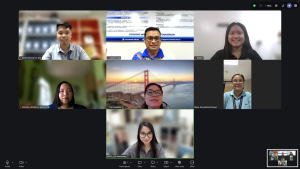

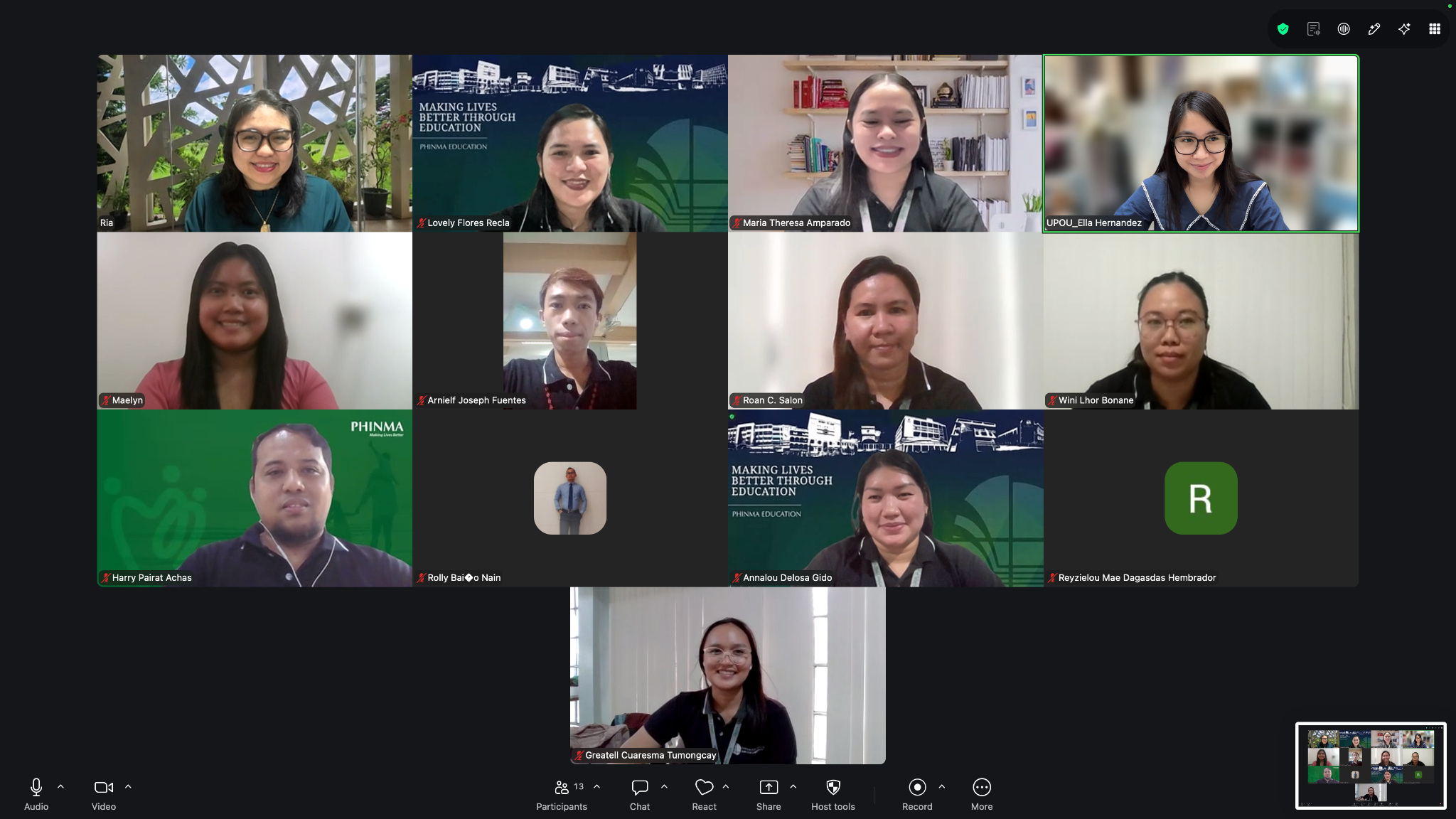
UPOU QAO Director Ria Valerie Cabanes (top, left) facilitates the discussion on UPOU’s ODeL practices, addressing key areas of interest raised by the PHINMA Cagayan de Oro College delegation.
The University of the Philippines Open University (UPOU) conducted an online benchmarking activity with PHINMA Cagayan de Oro College (PHINMA COC) on 13 October 2026 via videoconference to discuss best practices in implementing academic programs through Open and Distance eLearning (ODeL).
The activity focused on institutional policies and systems, instructional design and delivery, learning management systems (LMS), student support services, faculty development, and quality assurance mechanisms that support effective distance education.
The UPOU delegation was represented by the Quality Assurance Office (QAO) Director, Asst. Prof. Ria Valerie Cabanes, and QAO University Research Associate, Ms. Maelyn Pisueña. The PHINMA COC delegation was led by Ms. Lovely F. Recla-Agagdan, Academic Coordinator, with Ms. Reyzielou Mae Hembrador, Academic Secretary, and faculty members Dr. Harry Santiago P. Achas, Ms. Maria Theresa R. Amparado, Ms. Annalou Gido-Ligan, Ms. Roan Salon-Padrigao, Ms. Greatell C. Tumongcay, Mr. Rolly B. Nain, Ms. Wini Lhor C. Bonane, and Mr. Arnielf Joseph Fuentes.
During the discussion, Director Cabanes shared UPOU’s practices in developing quality online courses and learning materials through its Quality Circle, a pool of experts consisting of subject matter specialist, instructional designer, reviewer, multimedia specialist, and other experts. She also emphasized the importance of faculty training and multiple layers of course evaluation to ensure that instructional materials meet quality standards.
The participants inquired about the selection of an appropriate learning management system (LMS), the delivery of practical learning activities, and the provision of student support services. UPOU shared its experience using Moodle as its primary LMS and highlighted the importance of ensuring that learning materials are available at the beginning of each academic term to help students manage their learning schedules.
Recognizing that effective ODeL implementation requires more than technology, the discussion also covered technical assistance, accessible communication channels, and continuous support for both students and faculty members. The importance of faculty capability-building, particularly in course design for ODeL, was also highlighted.
PHINMA COC shared its ongoing preparations for ODeL implementation, particularly its School of Criminology, which is undergoing the application process and awaiting for the onsite evaluation by the Commission on Higher Education (CHED) technical panel. The institution also expressed interest in partnering with UPOU for faculty training and other capacity-building initiatives.
The benchmarking activity provided an opportunity for both institutions to exchange insights on strengthening ODeL delivery and explore potential collaboration in advancing accessible and quality higher education.
Through knowledge-sharing activities and institutional partnerships, UPOU continues to support initiatives that expand educational opportunities and strengthen the delivery of open and distance learning in the Philippines.
Written and photos by Marinela Hernandez | Edited by Primo G. Garcia, Anna Canas-Llamas