


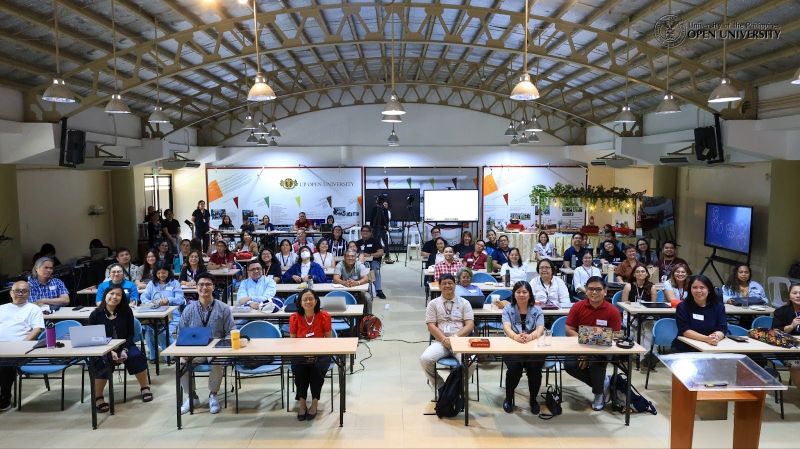
The participants of the Mini Faculty Conference aim to redesign their assessments to align with AI-enabled environments.
The University of the Philippines Open University (UPOU) conducted its first Mini Faculty Conference in the Age of Assessment in AI on 7-8 April 2026 at the Centennial Center for Digital Learning (CCDL) Auditorium, UPOU Headquarters, Los Baños, Laguna.
This one-and-a-half-day event was attended by UPOU regular faculty members, composed of program chairs and faculties-in-charge from the three Faculties of Study. The first day of the event began with the Welcome Remarks delivered by Chancellor Joane V. Serrano, who emphasized the importance of revisiting assessments to keep pace with ever-changing technological trends, particularly in AI-enabled environments. This was followed by Vice Chancellor Aurora V. Lacaste’s overview of the conference objectives, in which she outlined the expectations and discussed the pre-conference survey results.
The meat of the matter was discussed through the two keynote talks by Asst. Prof. Roja L. Rivera and Assoc. Prof. Juvy Lizette M. Gervacio, PhD. The first keynote talk, which delved into Revisiting Assessment Principles, was thoroughly discussed by Asst. Prof. Rivera, where she elaborated on the definition, purposes, and types of assessment .. Further, she also emphasized that educational beliefs can be a foundation of assessment decisions. During the latter part of her talk, she also discussed the features of effective assessment to scaffold the goal of redesigning the assessments.
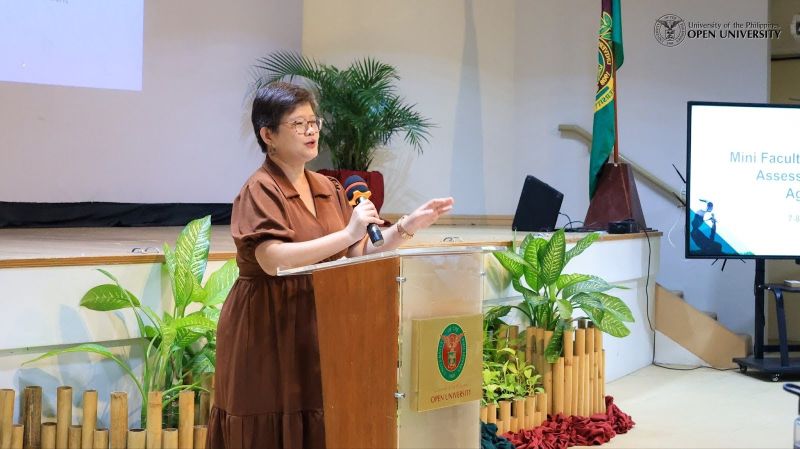
Asst. Prof. Rivera delved deeper into revisiting assessment principles for the faculty members to ponder upon.
Assoc. Prof. Gervacio focused on AI in Assessment, including all its advantages and disadvantages. She reiterated the benefits of AI, its risks and challenges, and the human-centered approach to its use. She also emphasized the need to redesign the human workload by using AI for first-pass feedback, primarily to handle common errors. She also suggested that AI can be used for formative assessments and that the faculty can reserve deep feedback for other significant assignments through one-on-one exchanges. Lastly, she emphasized the concepts of equity and inclusion, in which human-centered assessment recognizes that students have different levels of access to AI and varying prior experiences. Thus, there is a need to provide clear guidance, low-cost AI tool options, and flexible pathways to bolster student learning.
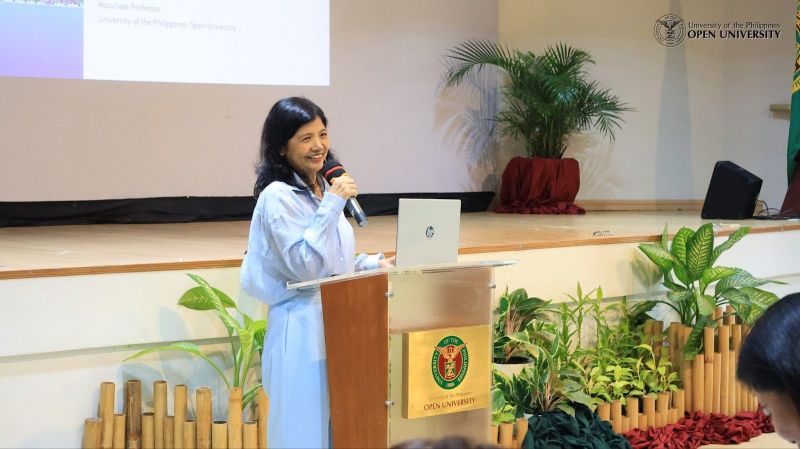
Assoc. Prof. Gervacio discussed “The Good, The Bad, and The Despicable Me” of AI in Assessment
After the talks, the participating faculty members were invited to engage in dialogue on the topics and share their questions and reflections through an Open Forum. Some participating faculty members also shared their insights on the topic of AI in the ODeL Classrooms. Dr. Reinald Adrian D. Pugoy and Asst. Prof. Lorena Jean D. Saludadez showed how Studiosity can help in providing feedback for learning while preserving student authorship and promoting critical thinking. Moreover, Prof. Jean A. Saludadez shared her best practices in facilitating engaging assessments in her courses.
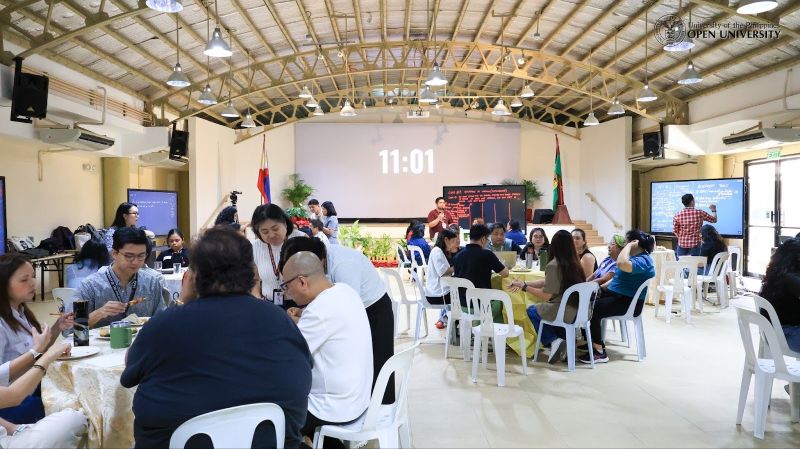
Participants of the Mini Faculty Conference huddle in groups for the World Cafe Method.
The most-awaited part of the first day was the World Café Method where six (6) groups were able to move around different cafés to discuss how AI affects summative, formative, and metacognitive assessments, as well as the implementation, feedback, and evaluation. After such, there was a harvest session where café owners organized the learnings that they captured during the brief discussions. While discussing, the other participants were also able to unleash their artistic prowess through the art (or seventh) café.
>
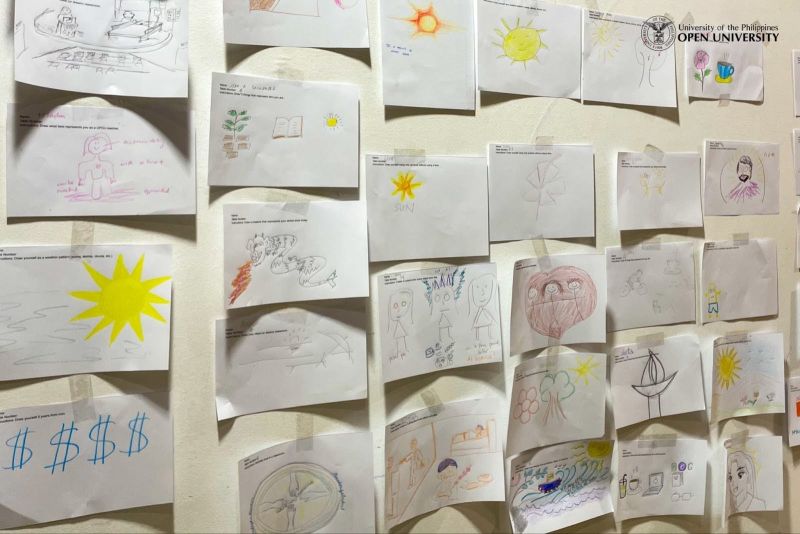
Participants display their art illustrations as output of the World Cafe.
On the second day, Ms. Alvie Simonette Q. Alip, University Researcher from OVCAA delivered a meaningful recap of the first day. She reiterated that “the best assessments are ones that are authentic, relevant, and engaging for students.” She also mentioned that we have to rethink assessments for it to be fun for our learners.
Mr. Lexter Mangubat, FED faculty member, then interacted with the faculty members by providing the executive synthesis of the World Cafe Method and engaging in an open forum to smooth out their concerns and consider more perspectives on the use of AI in assessments.
Two simultaneous parallel sessions were conducted next. Parallel Session 1 focused on Framework and Policy Making, participated by all Program Chairs (PCs). On the other hand, Parallel Session 2 delved into the redesign of assessments for Faculties-in-Charge (FICs). After these sessions, facilitators shared the consolidated learnings, which can be later adopted into their respective courses and be converted into future institutional policies.
The conduct of the Mini Faculty Conference in the Age of Assessment in AI establishes that this conversation is only just beginning. In a landscape where technology continues to evolve at an unprecedented pace, educators are called not only to adapt but to lead with intention. Assessment is no longer just a measure of learning—it is a reflection of how we value thinking, creativity, and integrity in an AI-enabled world. Moving forward, the challenge lies in designing approaches that are both innovative and grounded, ensuring that while tools may change, our commitment to meaningful, human-centered education remains constant. The conference outputs will inform UPOU’s academic policies and enhance capacity building as we move forward.
Written by Nikhaela Valenciano | Edited by Alvie Alip and Anna Cañas-Llamas | Photos by Office of Public Affairs