

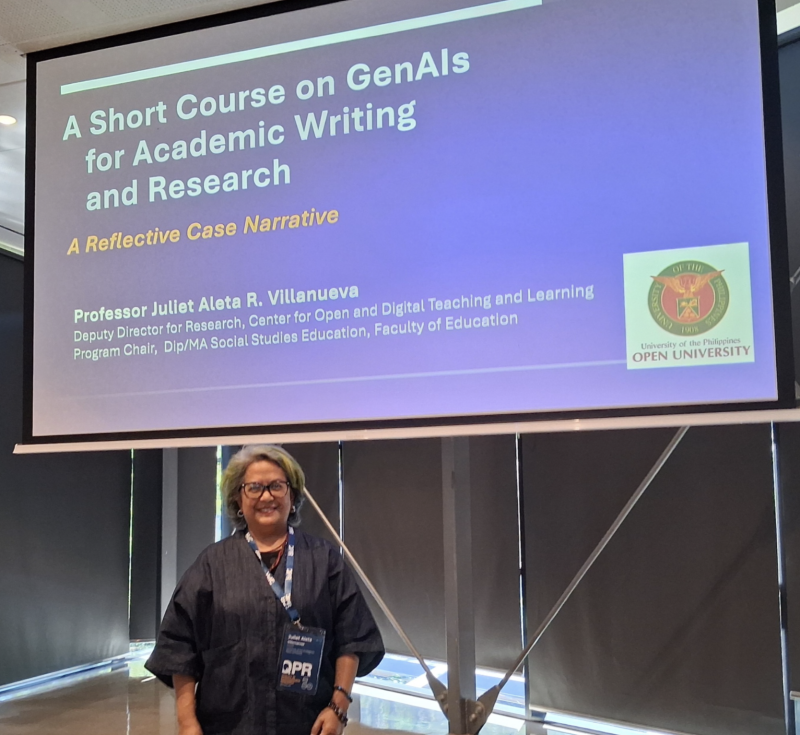
Professor J. Aleta R. Villanueva of the Faculty of Education and the Deputy Director for ODL Research of the UP Open University Center for Open and Digital Teaching and Learning (CODTL) recently participated in the Quality in Postgraduate Research 2026 conference with the theme ‘Transforming Graduate Research for the Future’ held on April 15-17, 2026 at Adelaide, Australia.
The conference aimed to bring together educational researchers, policy makers, research students, research degree supervisors, and university leaders for the purpose of better understanding the policies, processes, practices, pedagogies and theoretical frameworks which inform and govern doctoral and research masters education.
Professor Aleta completed two presentations, namely ‘A Short Course on GenAIs in Academic Writing and Research: A Reflective Case Narrative’, and ‘A Researcher Skills Development and Education Framework for Open and Distance eLearning Programs in Asia’.
Designing a course to promote responsible use of GenAI
The oral paper presentation highlighted the development of a short course on generative artificial intelligence (GenAIs) under the Faculty of Education Continuing Education Program (FEdCEP) intended to equip undergraduate and graduate-level research students with the proper mindset and skills to apply ethical use of GenAIs in academic writing and research. The course is informed by the research-based E.T.H.I.C.A.L GenAI framework and the AI literacy framework to emphasize the transformative possibilities of harmonious co-existence with AIs in higher education.
By grounding the course content on the responsible exploration and use of AIs, we demonstrated how a design thinking course development cycle for a short course prototype can feed into other initiatives. This approach ensures students, as stakeholders, are involved in the integration of GenAIs in the teaching and learning of research courses in an open university. The pilot run of this FEdCEP short course, eTL 194 Ethical GenAI Use in Academic Writing and Research, will happen this 2026.
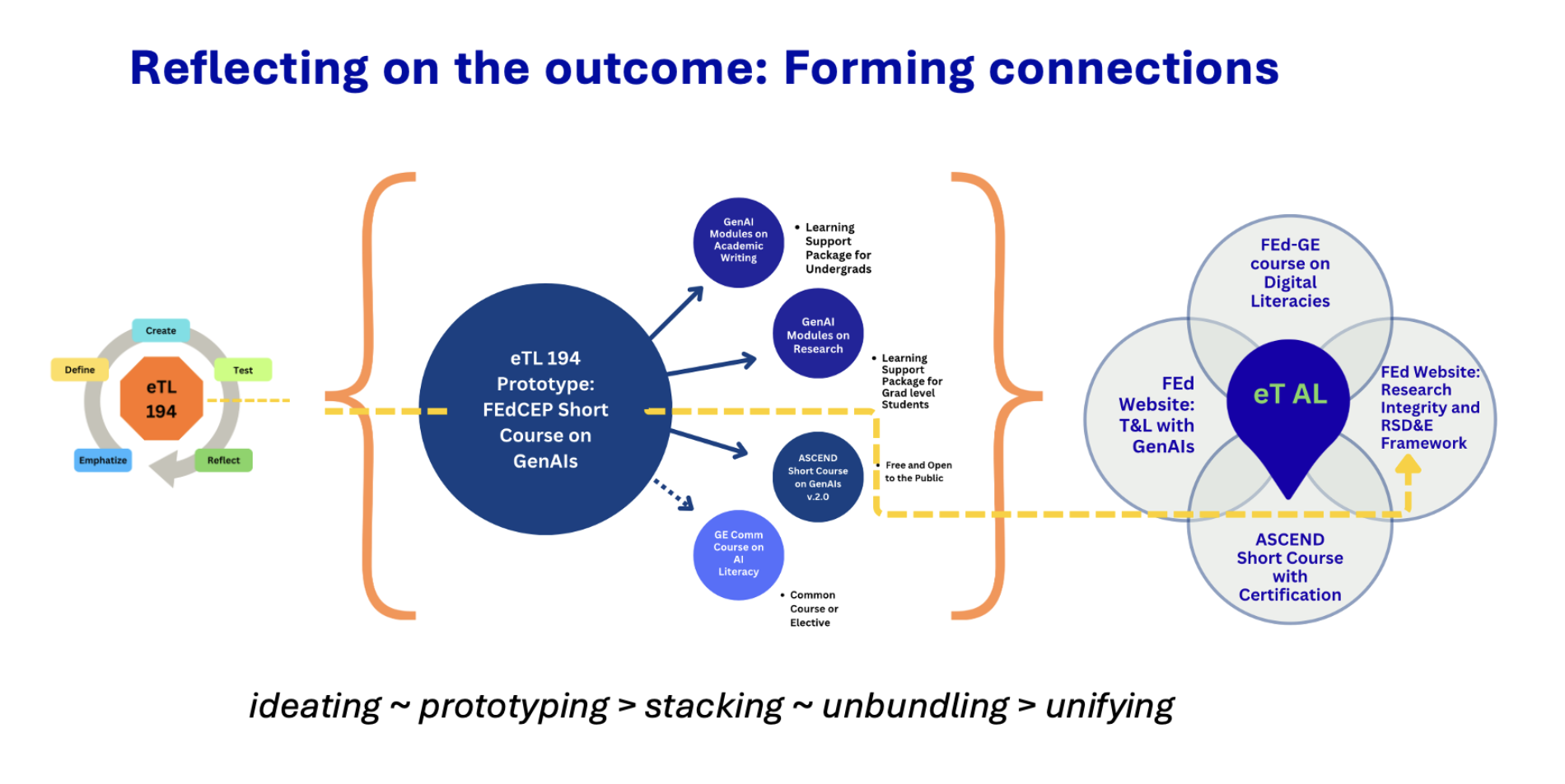
Design thinking approach used in developing the eTL 194 prototype and its offshoot initiatives
The development of eTL 194 short course is a work in progress and part of a collaborative research project “Towards a Harmonious Co-existence with GenAIs for Researcher Development and Education” under a small-scale UPOU research grant. Included in this action research project are Sophia Mondejar, CODTL student assistant from the Bachelor of Multimedia Studies; Veronica Dungao, Special Project student from the Bachelor of Education Studies under the CODTL Service Learning Option; Lexter Mangubat, Assistant Professor and Program Chair of Associate of Science in Instructional Design and Technology Degree; and Dr. Anna Sala-Bubare of Universitat Ramon Llul.
The collaboration highlights the roles of faculty-as-peers and students-as-partners in the CODTL Quality Circle Team applied to a nonformal course design and development with foreseen outputs in service of the UPOU community. This study illustrates how CODTL ODL Research collaborates with other faculties of study through research work and dissemination. Interestingly, the resulting narrative is a concrete example of the Scholarship of Online Teaching and Learning or SO2TL at work, under a valuable CODTL Research Thrust which neatly connects with the UPOU Faculty of Education’s eT AL Collaborative Research Framework.
Developing a framework for developing ODEL researchers
Professor Villanueva’s second presentation is a poster on ‘Researcher Skills Development and Education Framework (RD&E) for ODeL Programs’. The RD&E framework for ODeL Programs she presented emerged from autoethnographic reflections on a doctoral journey from the dual perspectives of a doctoral student and researcher development specialist. The study delved deeply into research as a form of self-expression and a reflective, scholarly, and collaborative act. Post-Phd and through this autoethnographic study, Prof. Villanueva realized that research is an intentional form of ‘practice’, a transformative act, and likewise a technology -enhanced practice given her research experiences within open and distance elearning programs. The framework, she and her co-author Dr. Douglas Eacersall initially developed in 2024, intends to guide collaborative research teams, inform research supervision practices and advocate for research student support mechanisms to ensure postgraduate student success in reimagined researcher education programs within online and distance learning environments.
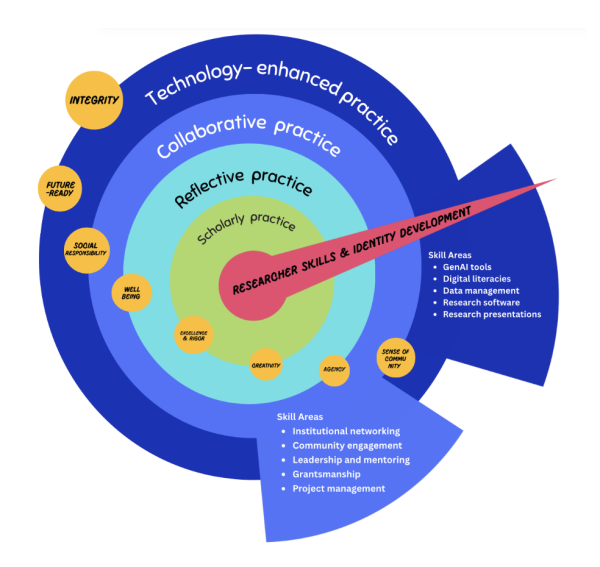
A Researcher Skills Development and Education Framework for ODeL Programs (Villanueva et al. 2026)
Recent validation of the content led to modifications in the framework’s elements and areas of work, which are now nested and no longer in sectioned parts to show connectedness across the elements, and particularly between researcher identity development and educational experiences. The core values have been maintained for each element. A dial was added to represent the development of researcher skills and researcher identity across these elements. Most of the skill areas were maintained, with ‘community engagement’ now added under research as a collaborative practice, indicating relatedness with research participants and their context, and to align with values of social responsibility and sense of community. Future directions include review of selected skillsets to improve alignment across elements, crafting of user guidelines and checklists for self and collaborative reflections and for research planning. This research is in collaboration with Dr. Shari Eunice San Pablo of the Faculty of Information Studies and Dr. Leo Mendel Rosario of the Faculty of Management and Development Studies and Dr. Douglas Eacersall, Adjunct from the UPOU Faculty of Education and a Researcher Development Specialist from the University of Southern Queensland.
The groundworking for the RD&E framework is conducted by the CODTL ODL Research unit in support of the Office of the Vice Chancellor for Academic Affairs’ strategic thrust in research and innovation and learning modality enhancement as part of UPOU’s vision as Transformative University of the Future. As such, the team looks forward to a round of validation with other open universities in Southeast Asia.
Acknowledgements
Professor Villanueva acknowledges the participation of the UPOU Faculty of Education, Faculty of Management and Development Studies and the support from the UP Office of the Vice President for Academic Affairs-System.
Crossposted from CODTL Website