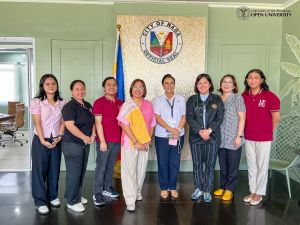

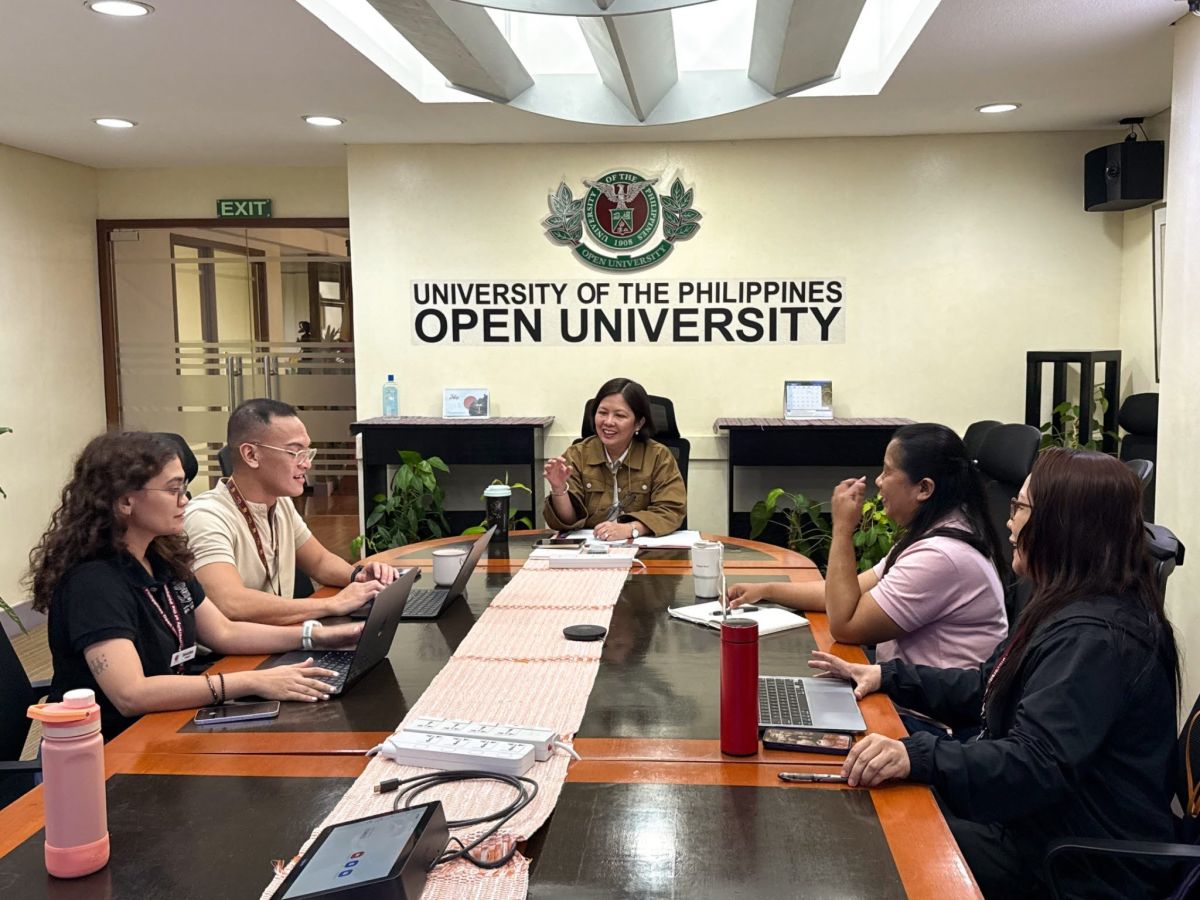
UPOU Chancellor Joane V. Serrano leads the inaugural meeting of the Dagitab Digital Transformation Committee on 28 July 2026, as members discuss e-spasyOU and other priority initiatives under the University’s digital transformation agenda.
The University of the Philippines Open University (UPOU) is advancing its digital transformation agenda through the Dagitab Initiative, with e-spasyOU emerging as one of its flagship projects to establish a nationwide network of community-based e-learning hubs. The initiative aims to consolidate the University’s digital learning initiatives, bridge the country’s digital divide, and foster sustainable community partnerships through e-learning hubs nationwide.
Named after the Hiligaynon and Kinaray-a word dagitab, meaning “electric spark” or “flash of electricity,” the Dagitab Digital Transformation Committee held its inaugural meeting on 28 July 2026 to identify priority projects for implementation. Among the initiatives discussed was the e-spasyOU, which reflects the University’s goal of extending the “spark” of digital learning to underserved and unserved communities (UUC) by connecting them to UPOU’s open and distance e-learning ecosystem through capacity development, digital devices, learning spaces, and open educational resources.
To support the project’s implementation, committee members discussed a flexible deployment framework that would allow e-spasyOU hubs to be established through multiple partnership models. These include institution-funded hubs supported by UPOU or external grants, privately funded hubs backed by corporate social responsibility (CSR) initiatives and philanthropic organizations, and community-led hubs established by local government units (LGUs), educational institutions, and non-government organizations in partnership with the University.
The committee also emphasized the need for standardized implementation across all hubs by developing the e-spasyOU Playbook, which will serve as the University’s operational guide for partner institutions. The playbook will define minimum hardware and software specifications, spatial layout recommendations, governance policies, and onboarding procedures to ensure consistency while allowing flexibility to address local community needs.
To maximize the University’s existing resources, members likewise discussed consolidating UPOU’s digital learning assets, including Massive Open Online Courses (MOOCs), microcredentials, open educational resources, and other learning materials into a unified package that can be deployed across partner hubs. The approach seeks to make the University’s educational offerings more accessible while minimizing duplication of efforts across offices.
A centralized monitoring and evaluation dashboard also forms part of the proposed framework. Once implemented, the platform will monitor hub utilization, learner participation, course completion rates, learning outcomes, and regional expansion to support evidence-based decision-making and continuous program improvement.
The committee outlined an implementation roadmap leading to the project’s targeted launch in November 2026. The roadmap includes consolidating existing university initiatives, developing governance and partnership frameworks, securing funding, establishing pilot hubs in communities, and integrating a monitoring system before the nationwide rollout.
UPOU Chancellor Joane V. Serrano led the inaugural meeting of the Dagitab Digital Transformation Committee together with Edmerson Calungsod, Assistant Professor from the Faculty of Management and Development Studies (FMDS); Dr. Emely Amoloza, Assistant Professor from the Faculty of Information and Communication Studies (FICS); Shaira Tanay, Assistant Professor from FICS; and Rubielita Parcon, University Research Associate from the Faculty of Education (FEd).
As discussions concluded, committee members underscored that the initiative also reflects UPOU’s evolving approach to accessibility. While open and distance e-learning (ODeL) removes many barriers to education, the University recognizes that digital access remains uneven across the country. Through e-spasyOU, UPOU aims to extend the ODeL’s reach beyond the online environment by bringing learning resources, connectivity, and support directly to underserved and unserved communities. In doing so, the University reaffirms its commitment to making quality education accessible, not only online, but also where learners need it most.
Written by Shaira Tanay | Edited by Joane V. Serrano and Emely Amoloza