


The second phase of the Policy Research Ideation through Mentorship and Engagement (PRIME) program was conducted for the Section Heads of the Department of the Interior and Local Government (DILG) on 17 November 2025 at the DILG Central Office in Quezon City.
PRIME, a collaboration between the Faculty of Management and Development Studies, University of the Philippines Open University (FMDS, UPOU) and the Local Government Academy (LGA) of the DILG, draws inspiration from the triple helix innovation model which emphasizes collaboration between academia, industry, and government for regional development from research & development and innovation. Building on the results of PRIME Phase 1 (policy research ideation) and connecting it to the proposed PRIME Phase 3 (mentorship and engagement), PRIME Phase 2 consists of a structured training framework called “Idea2Influence” designed and developed to equip participants with researchers’ knowledge, skills, and competencies necessary for conducting effective, relevant, and impactful research that informs public policy.
The learning event was opened by LGA’s Assistant Director Esmeralda Daphne Purnell, CESO IV. AD Purnell highlighted the importance of bridging policy ideas to real-world influence, empowering the DILG to become a truly responsive government institution.
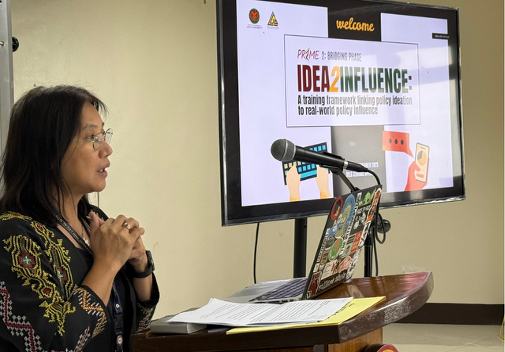 LGA Assistant Director Esmeralda Daphne Purnell, CESO IV, delivering the opening message.
PRIME Phase 2 is composed of three components. In Component 1, FMDS Senior Lecturer Lianne Angelico Depante provided a solid grounding on the fundamentals of policy research and its relevance to local governance, establishing the analytical framework for the rest of the program.
In Component 2, FMDS Senior Lecturer Regina Mendoza-Armiendo shared a specific method in policy analysis and how the results can be communicated effectively to decision-makers and other stakeholders. During the workshop simulation that followed, participants demonstrated excellent comprehension by producing well-crafted policy recommendations aligned with the case studies. Participants were divided into two groups, with one member acting as Mayor to deliver responses to the respective policy pitches.
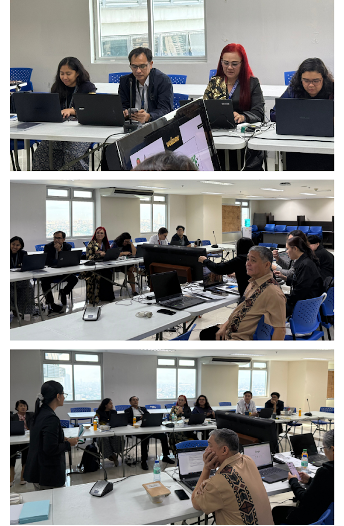 Policy Pitch Presentation and Feedbacking with the participants
The training-workshop ended with the coverage of Component 3 by FMDS Assistant Professor and PRIME Program Leader Leo Mendel Rosario, PhD. His session on managing research teams tied the discussions together, emphasizing the balance of technical expertise and people management in delivering quality policy work.
The implementation of the PRIME 2: Bridging Phase Training Framework enabled participants to develop a clear understanding of the policy research cycle and its role in supporting sound policymaking, strengthen their ability to communicate research findings effectively to policy stakeholders, and apply appropriate research management tools and techniques in real-world policy contexts. These reinforced their learnings from Phase 1 and prepared them to undertake Phase 3.
Written by Regina Mendoza-Armiendo • Edited by Larry N. Cruz