As the nation celebrates National Arts Month 2026 with the theme “Ani ng Sining, Katotohanan at Giting,” we spoke with three faculty artists from UP Open University (UPOU) about the role of art in education, society, and cultural change.
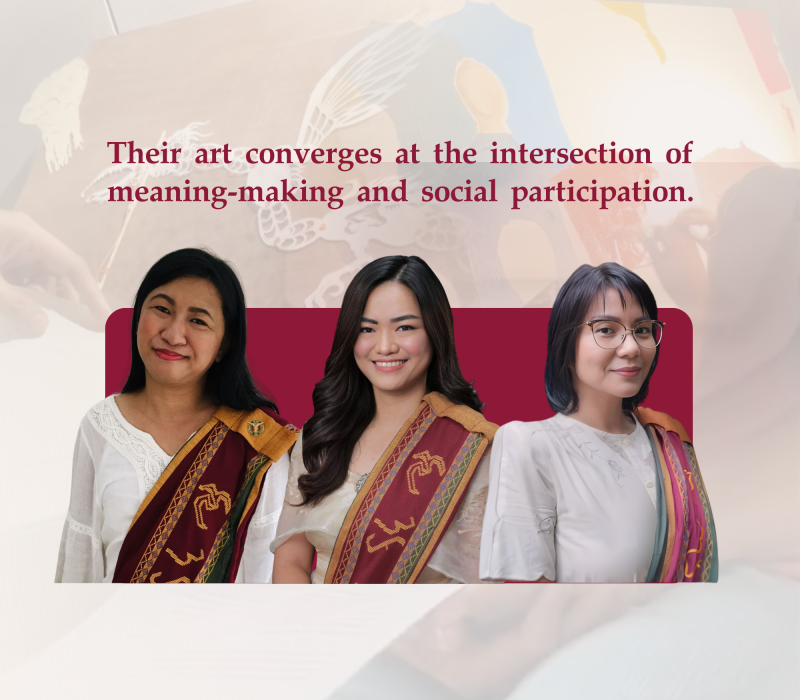
UPOU celebrates the diversity of creative expression within its academic community where teaching, research, and artistry intersect. For this year’s National Arts Month, three faculty artists – Assistant Professor Roda Tajon, Assistant Professor Shari Eunice San Pablo, and Assistant Professor Alice Sarmiento – are featured. Each represents a distinct yet intersecting art form: visual and digital art, literature, and art curatorship and exhibition practice that offer rich perspectives on how art can be tapped for teaching, advocating, and connecting communities.
Despite having different mediums, their arts meet at a common intersection of using art as a means of meaning-making and social participation.
Embracing uncertainty through visual art
Asst. Prof. San Pablo’s art practice spans different mediums from photography and traditional acrylic painting to fusing canvas with digital animation via projection mapping. She currently explores projection mapping aimed at creating immersive, evolving works. Art has taught her to embrace uncertainty, which reflects her preference for experimentation over rigid formulas.
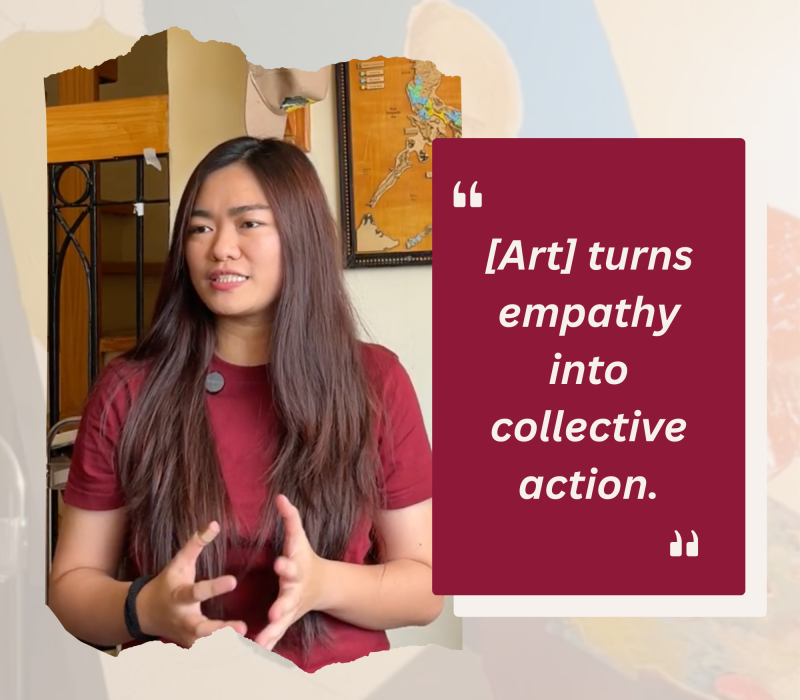
Asst. Professor Shari Eunice T. San Pablo is a visual artist and program chair of the Associate of Arts in Digital Design and Art (AADDA) at the Faculty of Information and Communication Studies.
“And this directly complements my role as an educator, where teaching creativity to students can be a challenge,” said Asst. Prof. San Pablo as she explained the relationship between art and teaching. “What we can do is build strong foundations that will serve them, helping to foster exploration and self-awareness so that their authentic creativity emerges naturally.”
Literature as a voice for the marginalized
Asst. Prof. Tajon’s works are expressed through creative writing and poetry. She grounds her pieces close to her lived personal experiences and to the narratives of women including both cisgender and transgender experiences. Her writing highlights shared struggles against discrimination, marginalization, and violence.
She explained, “Karaniwan kong isinusulat ang danas ng kababaihan, cisgender man o transgender. At naniniwala ako na hindi dapat pinagbabangga o pinagsasabong ang mga magkabaro. Hindi ito usapin kung sino ang tunay na babae. Bagkus usapin ito ng danas, ng pagkakaparehas ng danas at kung papaano nag-iintercept yung kanilang danas kapwa nakararanas ng diskriminasyon, ng pagsasantabi at ng karahasan. At kailangan na tayong umalta sa usapin lamang ng katawan at itoon natin ang pansin sa iba pang mahalagang usapin tulad ng identidad, uri ng oriyentasyong seksual, at iba pa.”
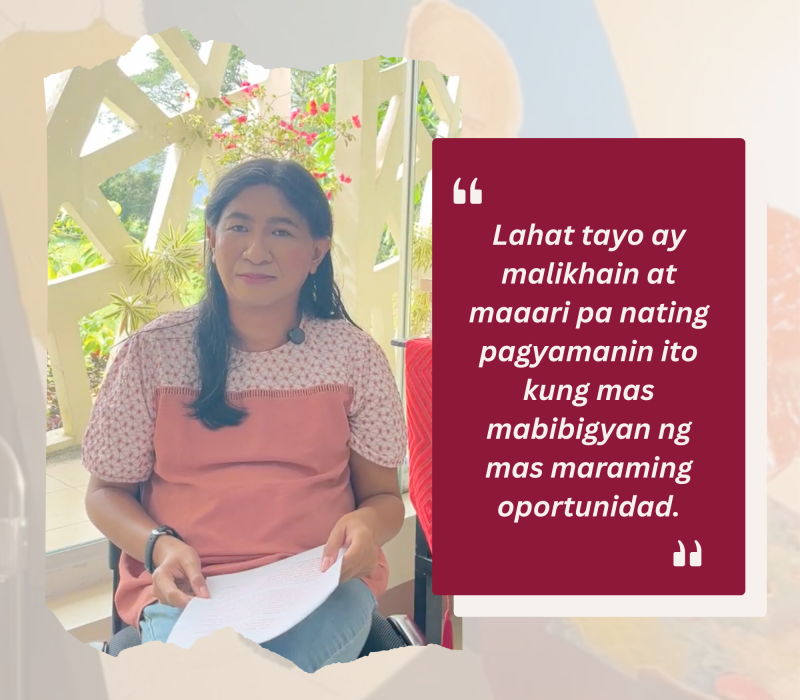
Asst. Prof. Roda Tajon is a writer and community organizer. She teaches communication, gender studies, and popular culture at the Faculty of Information and Communication Studies.
Curating spaces for creative purpose
Meanwhile, Asst. Prof. Sarmeinto works within the field of art curatorship, a practice she defines as the process of selecting artists and their work to make space for. She underscored curatorship as more than exhibition-making or employment.
“I believe work should be beyond employment and be towards the creation of something meaningful to you. And I think that it’s important to be around people, specifically artists, who can see beyond motives of employment and profit, especially if you are working in an educational institution,” Sarmiento said.
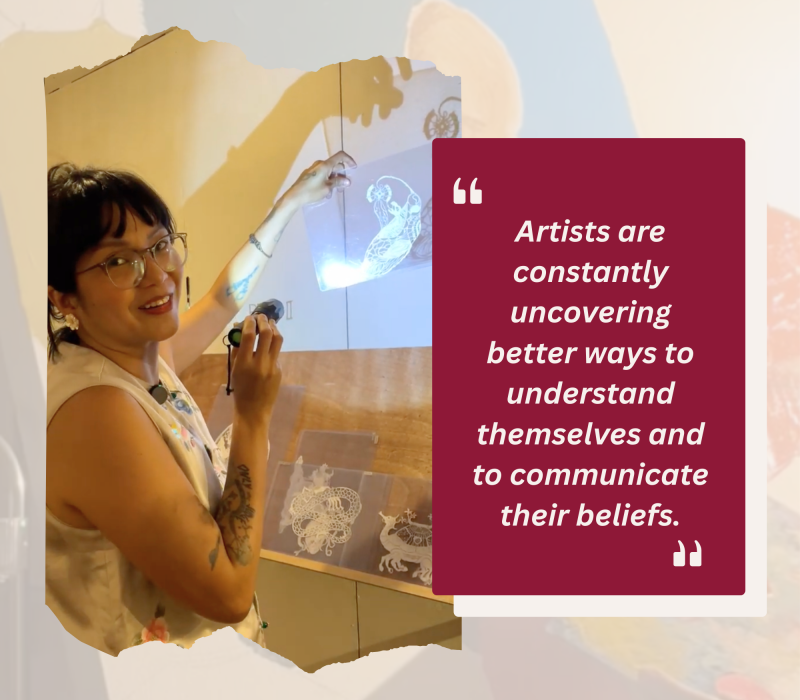
Asst. Prof. Alice Sarmiento is an art critic, curator, and writer. She teaches in the Associate of Arts in Digital Design and Art (AADDA) and Bachelor of Arts in Multimedia Studies (BAMS) at the Faculty of Information and Communication Studies.
Art, society, and cultural development
In the Philippines, a developing country with many competing needs and limited resources, the role of the arts in society has long been debated and often overlooked. When asked about the role of art in a developing country like the Philippines, the three artists agree: art both reflects society and helps shape it.
For Asst. Prof. Tajon, a writer’s words reflect our collective realities as well as create new possibilities: “At hindi lamang ito danas ng individual, kung hindi ang danas ng isang individual na nagsulat ay maaaring danas din ng bayan at repleksyon din kung paano ipinapakita ang kalagayan ng lipunan.” She explains further, “Malaki yung papel ng sining ng panitikan para sa kaunlaran dahil nililikha nito ang mga alternatibong lipunan na gusto nating tanawin sa kinabukasan.”
San Pablo describes art as a universal language, one that transcends words and transforms empathy into action. In a country shaped by complex social realities, art becomes a mirror that reveals injustice while simultaneously igniting the desire for change. She sees art as a catalyst that helps people imagine and demand better futures.
“In the Philippines, our lived realities are seen in the art that we meet,” said Asst. Prof. San Pablo as she expressed the role of arts in our country’s development. “ It also ignites a spark within us that prompts us to move, and this spark is what drives social development. It turns empathy into collective action. It’s the reason why an illustration or a photo can go viral and start a movement. Art gives us the vocabulary to demand better, allowing us to see the way things are and what they are.”
For Sarmiento, exhibitions serve as cultural tools that foster dialogue, shape inclusive values, and cultivate shared understanding and collective imagination.
She shared, “Artists are constantly uncovering better ways to understand themselves and to communicate their beliefs, especially when it comes to what could make the world a better place. When it comes to a developing country like the Philippines, these types of practices are very important to foster the kind of culture that we want, or a kind of culture that is beneficial to everybody, not only those at the top.”
Making art accessible and inclusive
For art’s potential for transformation to be realized, it needs to be made more accessible to more people.
“We can make art more accessible by meeting the people where they are, instead of having it in places that not everyone can access,” Asst. Prof. San Pablo said. She believes that bringing art into public and community spaces, such as schools, local hubs, and everyday environments, allows people to move beyond being mere spectators and become active participants in the creative process.
Tajon highlights the role of small and independent presses in democratizing literature. While mainstream publishing broadens reach, independent platforms give marginalized voices a space. By reviving interest in reading and writing and recognizing everyone’s capacity to tell stories, literature becomes a shared public good. She said, “Lahat tayo ay malikhain at maaari pa nating pagyamanin nito kung mas mabibigyan ng mas maraming oportunidad ang panitikan para maituro at para maibahagi para sa mas marami.”
Drawing from her years of curatorial work, Sarmiento acknowledges the challenges of resources in the arts. Yet she insists that accessibility starts at the community level. “When we talk about access to art or access to cultural production, I think it far more meaningful and a better use of our energy to look to our direct communities and maybe direct our efforts towards mutual aid because ultimately it’s about who is in your immediate vicinity when you want to do something creative,” she emphasized.
Whether through immersive visuals, resonant words, or thoughtfully curated spaces, the work of these UPOU artists reminds us that art is inherently intertwined with our experiences as individuals and as a society. Through their practices, UPOU’s celebration of National Arts Month 2026 showcases a rich harvest of creativity.
Written and visual layout by Marinela Hernandez | Edited by Anna Canas-Lamas and Primo Garcia