


Celebrating National Arts Month, we spotlight the graphic novel Ka Sora and the story of Melchora Aquino, brought to life by Dr. Grace Alfonso.
Recently, there has been a spate of movies depicting the heroic lives of our national heroes. While a few have been box-office hits, others have sparked controversy and ignited debates about the true purpose of bringing these biographical stories to life on film.
The UP Open University contributed to this discourse not through films, but through the creation of the graphic novel Ka Sora, developed by Dr. Grace Alfonso, Professor Emeritus, former University Artist, and former Chancellor of UP Open University. The novel depicts the life of Melchora Aquino, also known as the Mother of the Philippine Revolution, based on archival research and interviews conducted by Dr. Alfonso with Aquino’s descendants.
Funded by the UP System’s Emerging Interdisciplinary Research (EIDR) Program, the graphic novel was also offered as a massive open online course (MOOC), with the novel serving as the main course material. The four-week program attracted hundreds of learners, who explored not only Ka Sora’s role in the Philippine Revolution but also the broader impact of her contributions on gender politics and the shaping of present-day Filipino identities and the nation itself.
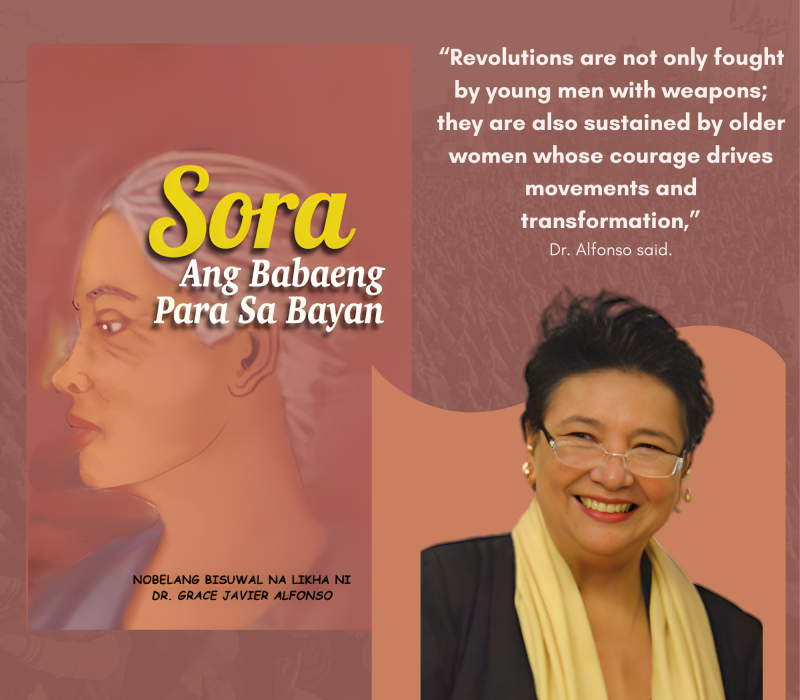
Dr.Grace Alfonso created the graphic novel to highlight the role of women and the elderly in the revolution and transformation of the nation.
Reclaiming space for the elderly and women
“Revolutions are not only fought by young men with weapons; they are also sustained by older women whose courage drives movements and transformation,” Dr. Alfonso said, explaining why she chose to tell Ka Sora’s story. “Their stories deserve to be seen, not sidelined. Older women are often undervalued and stereotyped as weak, slow, or just waiting for death. But in reality, many don’t give up so easily.”
Aside from giving representation to older women, Ka Sora’s story also highlights women’s agency in revolutionary history. “Our traditional textbooks are centered on male heroes,” Dr. Alfonso explained. “This graphic novel makes visible the often-invisible work of women—feeding revolutionaries, sheltering the displaced and wounded, enduring interrogation, and making moral choices under threat.”
Bringing Ka Sora to Life in Panels
In this modern age, when many young people learn history through films or the internet, Dr. Alfonso chose to portray Tandang Sora’s life and journey as a revolutionary through a graphic novel, a medium she fondly remembered from her own youth. “When I was a kid, the first thing I read were comics,” she said. “By choosing this form, Tandang Sora’s story moves from one generation to another, bringing her from elite historical discourse into popular culture.”
The recent popularity of manga and other online comics testifies to their enduring power as a medium for storytelling. Dr. Alfonso said that the graphic novel is a sequential art, which means that the story is told through a sequence of images arranged in order, often combined with text.
In a graphic novel or comic, scenes are shown in panels or boxes that depict the characters and what they are saying or doing. The size and position of each panel can highlight the characters or moments that are most important in a scene.
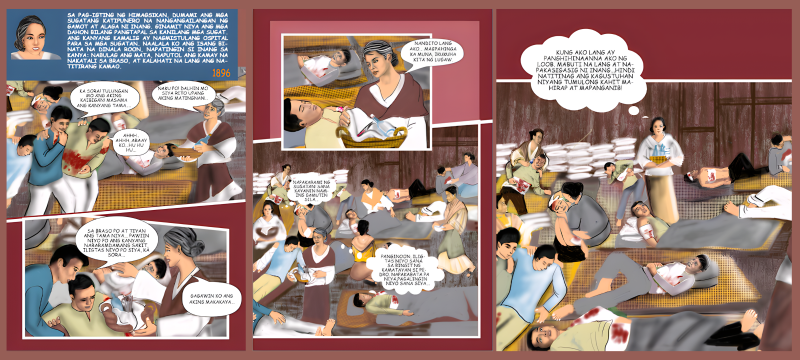
Panels showing Ka Sora tending to wounded revolutionaries.
Dr. Alfonso used these visual possibilities to spotlight Ka Sora and her role in the revolution. “Through panel sizes, perspective, and placement, she is often in the foreground, and given narrative space that history has long denied her,” Dr. Alfonso added.
It also bridges the gap between older and younger generations. “When readers see in the novel how an older woman navigates violence and colonial power with moral courage, it really comes through, making her struggle immediate and relatable to events happening today. It merges time and space,” she added.
“It was very important for me to show the details,” Dr. Alfonso said, explaining why she chose a more painterly style for the novel instead of a minimalist approach. “I had to visually recreate the milieu, so it fits the story and the time period—the physical and social setting of that era. That’s why I researched how the houses looked, the people around Sora, how they dressed, and even the coins, churches, and uniforms. Those details are very important in telling the story of Melchora Aquino and making it feel real and credible.”
Stories Across Time
Ka Sora’s life story is told in a non-linear way. Readers may notice overlapping frames, where space and time seem to dissolve or occur simultaneously. The story begins with Sora returning to the Philippines from exile in Guam, with events from her life revealed through flashbacks narrated by both Sora and her children. “In each frame, there is also the visualization of generations,” Dr. Alfonso explained. “It comes through the memories of Sora and the process of remembering her—it stays with you.”
This approach was intentional. “The form resists linear, hero-centric storytelling,” Dr. Alfonso said. “Through the panels and fragmented time, the graphic novel shows revolutionary events not just from the point of view of leaders, but as a collective experience. This highlights how women and elders contributed to the movement. These elements are structurally essential, not peripheral.”
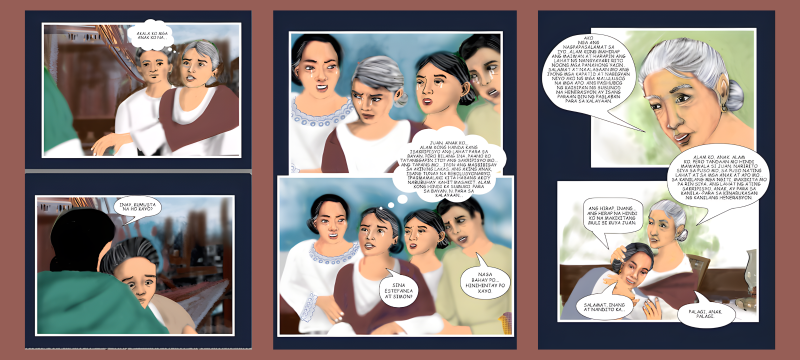
Ka Sora in her later years, following her exile in Guam.
For Dr. Alfonso, creating the graphic novel was not just a creative exercise or simply telling an inspiring story. By incorporating the voices of Ka Sora’s descendants into the narrative, the novel reclaims her memory through visual storytelling. “It’s really about remembering Sora and what she stands for,” she explained. “It’s reclaiming memory through embodiment through the visual. She is aged, vulnerable, yet incredibly resilient, and she becomes a site of resistance. This graphic novel foregrounds bodies in ways that prose sometimes cannot.”
The graphic novel Ka Sora makes learning history an immersive, visual experience. It invites readers to connect with the past while reflecting on the issues facing the nation today. It shows that Ka Sora’s moral courage, compassion, and resilience are virtues as revolutionary as those demonstrated by the key leaders of the Philippine Revolution. The lessons of Ka Sora’s life continue to resonate deeply in our time.
Written by Primo G. Garcia | Graphics by Marinela Hernandez