
As part of Open Education Month, we feature a study by Dr. Finaflor Taylan showing how open and distance elearning (ODeL) helps Filipino social workers access graduate programs that fit their work and family schedules. Through UPOU’s flexible online learning, students gain skills, confidence, and leadership to deliver care and drive meaningful social change.
Social workers play an important role in society. Not only do they facilitate the provision of care, but they also help maintain the social fabric by ensuring that the poor and marginalized are not overlooked and left behind. This is especially true in the Philippines, where social inequity is more entrenched.
Yet despite their important work, Filipino social workers face heavy workloads, low pay, job insecurity, and constant pressure to grow professionally. Graduate studies are crucial to equip them to create policies and programs that address society’s complex needs. If they dedicate themselves to caring for others, shouldn’t we also ensure that their own lifelong learning and growth are fully supported?
It is because of these challenges that the UP Open University launched its Diploma and Master’s programs in Social Work through open and distance learning in 1998. While more than a hundred schools in the Philippines offer social work, most only provide a bachelor’s degree. Only a few offer master’s programs, and most still rely on traditional face-to-face classes, making it hard for professionals to balance work and study.
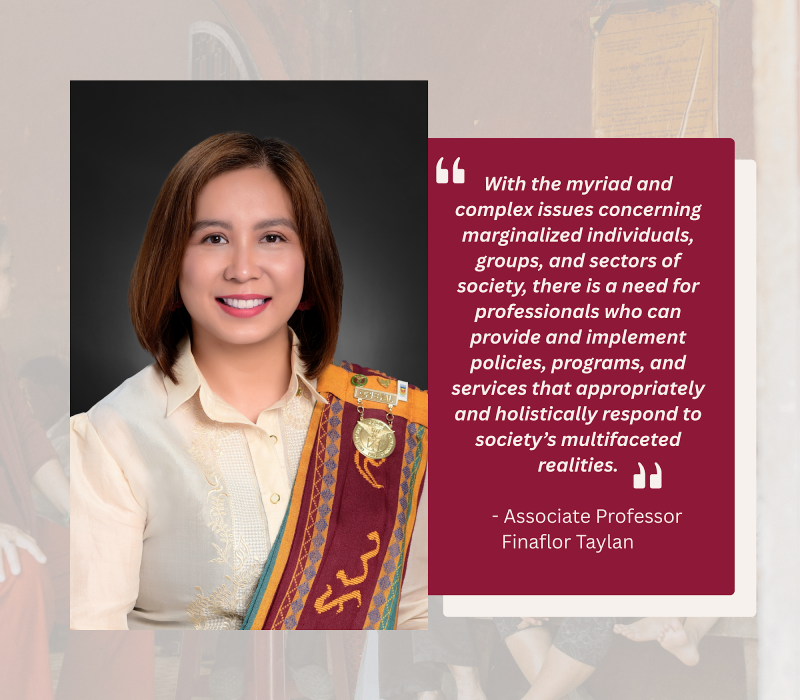
Dr. Finaflor Taylan is an Associate Professor of Social Work at UPOU’s Faculty of Management and Development Studies.
An exploratory study by UPOU Associate Professor Finaflor Taylan found that the UPOU Social Work program has expanded access to quality education for social work professionals. Interviews with 12 students showed that the program’s flexible learning supports work, family, and location needs while boosting analytical skills, confidence, and professional competence, with benefits extending to supervisees and client communities. As Dr. Taylan noted, “The participants explained that studying in the UPOU Social Work program enhances their cognitive abilities and confidence in their work and, more importantly, in themselves.”
Access to the program is supported by factors such as reliable internet, the availability of computers, and the diverse backgrounds of students, which enrich discussions. Dr. Taylan cited that participants find it “important for students to come from diverse backgrounds, where learners’ experiences can be a rich source of their social work education, besides the lectures and inputs from their teachers.”
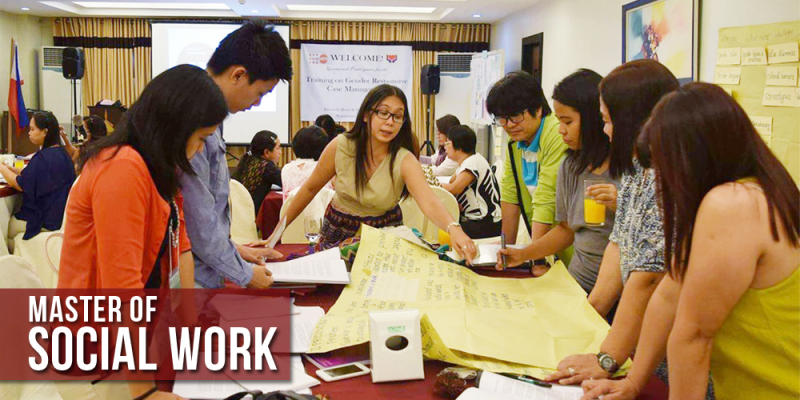
The Master of Social Work develops social work professionals’ skills and leadership through flexible online learning and hands-on field experience.
“The flexible nature and quality of the program delivery enable students to manage their time well and become more flexible with other personal and work obligations,” a benefit made possible by the program’s use of asynchronous online classes, accessible materials, timely faculty feedback, relevant course content, and interactive discussion boards.
At the same time, challenges remain. Personal obstacles such as poor internet, time management pressures, heavy workloads, and the isolation of self-paced learning can limit participation. “There is also difficulty thoroughly understanding some of the concepts discussed in certain courses, as some students may feel left mostly to self-study,” Dr. Taylan cited one participant as saying.
Program-related hurdles include delayed faculty feedback, limited face-to-face interaction, repetitive activities, and challenges in coordinating group work or securing fieldwork placements. While learners value group interaction, “it becomes too difficult as classmates are located all over the world and finding a common time and coordinating as a group can be challenging as well,” as she noted from a participant’s experience.
Participants suggested ways to improve the program, including more online materials such as videos and locally relevant resources, flexible options for fieldwork, stronger partnerships with social welfare agencies, more opportunities for social interaction and learning validation, and a wider range of electives.
With the country facing socioeconomic challenges and frequent natural disasters, there is a growing need for social work professionals who are trained not only to deliver social services but also to design and manage social development programs that drive meaningful social change. Through its Open and Distance eLearning (ODeL), UPOU equips social workers with advanced skills in practice and leadership to tackle the complex issues facing local communities.
Beyond strengthening professional skills, the program also transforms learners personally. As one student said, “I gained confidence and courage when I started studying at UPOU. I hope the University realizes the impact it has on students like me, enlightening and inspiring us about life and the profession.”
Written by Primo Garcia | Edited by Anna Cañas-Llamas | Visual layout by Marinela Hernandez