



AI can enhance teaching and learning but only if students trust the learning management system (or digital learning platform) and can use it easily. UPOU Associate Professor Reinald Pugoy’s research says that being ready for AI comes from daily interaction with reliable educational technology.
“When systems operate intuitively and reliably, users are more confident and more receptive to AI-enhanced features,” said Reinald Adrian D. Pugoy in his study on learning management system usability and artificial intelligence adoption readiness at the University of the Philippines Open University (UPOU).
The arrival of AI in recent years has been widely viewed as a disruptive force in education. And yet, recent reports suggest that many universities still lack clear policies guiding the use of AI in their institutions, indicating that educational systems have yet to fully grasp the specific role of AI in academic programs. Some universities, including UPOU, have begun crafting guidelines on AI use to maximize its affordances for learning while minimizing risks, promoting ethical and responsible use of the technology.
Debates on AI in education remain heated: some see it as a bane that encourages overreliance and weakens critical thinking and writing skills, while others view it as an opportunity to redefine teaching and learning, especially in assessment design in the years ahead.
AI goes beyond just technology
For Dr.Pugoy, Associate Professor at UP Open University, the integration of AI in education opens a wide range of pedagogical possibilities, including personalised learning, intelligent tutoring systems, plagiarism detection, automated assessment, and student performance prediction. If AI is indeed set to become a pervasive force reshaping how people learn, work, and govern, how should educational institutions prepare for it? How can AI functionalities be incorporated in ways that are more accessible to learners and that meaningfully support digital transformation?
He framed the issue by treating AI accessibility not as a separate concern, but as part of the learning management system (LMS) itself. He argued that before introducing Artificial Intelligence (AI) in a university’s online learning platform, the LMS must be intuitive and user-friendly. If students struggle with the basics, they are less likely to trust or embrace AI and its potential to enhance learning.
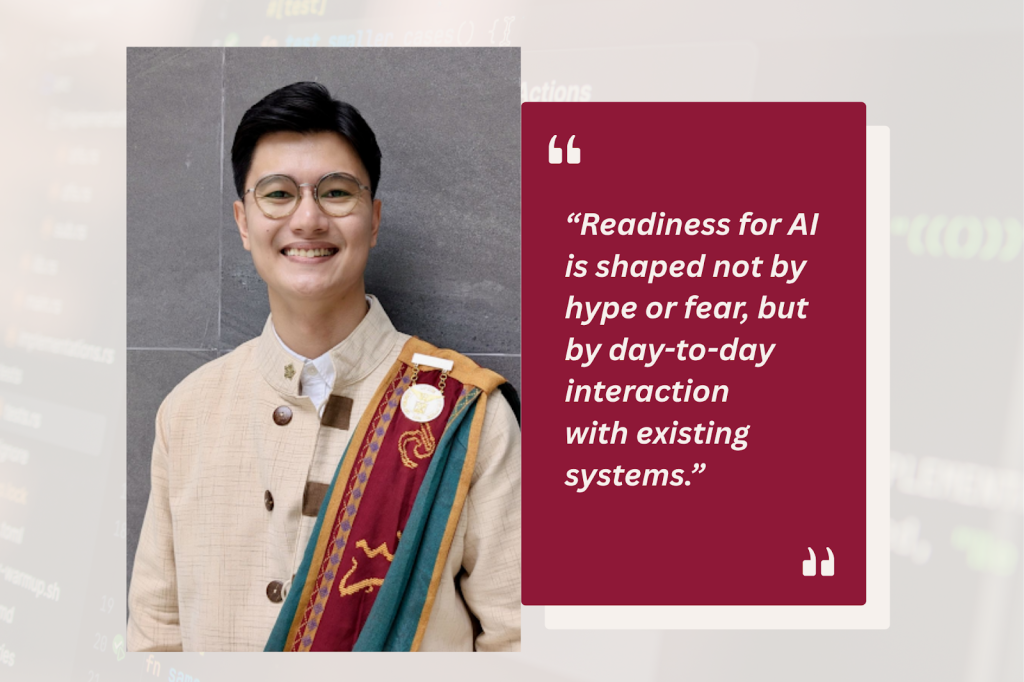
Dr. Reinald Adrian D. Pugoy is an Associate Professor at University of the Philippines Open University and Director of its ICT Development Office
What students say
Based on a survey of 73 UPOU students and learners, the study looked at how easy to use the university’s online learning system is and how ready students are to adopt AI features. It measured usability with a standard tool called the System Usability Scale (SUS) and attitudes toward AI using the General Attitudes Towards Artificial Intelligence Scale (GAAIS), while open-ended questions captured students’ challenges with the system.
The LMS scored an average of 67.43 out of 100, very close to the acceptable benchmark of 68. Students say the LMS works well, though navigation, layout, and locating basic items like grades could be easier. Overall, students view AI positively, though they have concerns about replacing human interaction, potential displacement of humans, reliability, ethics, and data privacy.
A very interesting finding from the study showed that students who rated the LMS as easy to use were more optimistic about AI in education, while those who found the LMS challenging to use were more skeptical of AI and worried about issues like surveillance and lack of control. This shows that usability can pave the way for AI adoption, since intuitive and reliable systems build trust, which in turn increases readiness for AI and other intelligent innovations.
Making AI work in learning
To prepare for AI-enabled learning, Dr. Pugoy said that educational institutions need to regularly refine the consistency, navigation, accessibility, and responsiveness of their digital platforms. Usability goes beyond technology because it shapes users’ trust and how effectively they use AI.
AI features need to be integrated with a clear purpose. “Rather than treating AI as a plug-and-play solution, universities must align its use with real user needs and specific learning contexts,” he said.
He stressed that AI readiness requires informed confidence, calling on universities to train faculty and students on the ethical and responsible use of AI and to dispel common myths and misconceptions.
He also explained, “Transparency should be embedded as a core design principle to reduce uncertainty,” meaning institutions must clearly communicate what AI features are implemented, how data is managed, and where human oversight applies. This promotes informed consent, reinforces accountability, and builds trust in AI-enabled systems.
Finally, involving users in the design improves the system. “Institutions must create channels for learners and educators to regularly provide feedback on usability and AI features,” he noted.
This research underscores the importance of integrating AI within the broader learning context. Learners were open to AI, but they expected it to make learning easier and more engaging, not more complicated. As Dr. Pugoy explained, “Readiness for AI is shaped not by hype or fear, but by day-to-day interaction with existing systems.”
Written by Primo Garcia | Edited by Reinald Adrian Pugoy | Visual layout by Marinela Hernandez