

When institutions invest in teachers, they invest not only in educators themselves, but also in the communities, futures, and generations that these educators help shape. Guided by this shared belief, the University of the Philippines Open University (UPOU) and the Filipino Educators’ Association in Thailand (FEAT) have formalized a partnership aimed at expanding opportunities for Filipino educators through professional development, academic engagement, and lifelong learning initiatives.
The partnership, formalized through a Memorandum of Understanding (MOU), reflects a common commitment to supporting Filipino teachers wherever they may be. Through the collaboration, UPOU and FEAT will explore joint academic and professional development initiatives, support professional engagement opportunities, collaborate in the delivery of Massive Open Online Courses (MOOCs), and share relevant resources, expertise, and information.
For UPOU Chancellor Dr. Joane V. Serrano, the partnership is rooted in the transformative role that teachers play in society.
“As we always believe, when we invest in teachers, we invest in the future of our nation and our people. This collaboration is highly beneficial for both parties and, most importantly, for the educators it serves,” she shared.
The same vision was echoed by FEAT Founder and Chairperson Dr. Analiza Perez-Amurao, who emphasized the importance of creating opportunities for Filipino educators beyond national borders.
“I take great pride in this partnership with UPOU through UP VINTA (UP Ventures for International and Transformative Academia). This reflects our shared commitment to help expand opportunities for Filipino educators beyond borders,” she said.
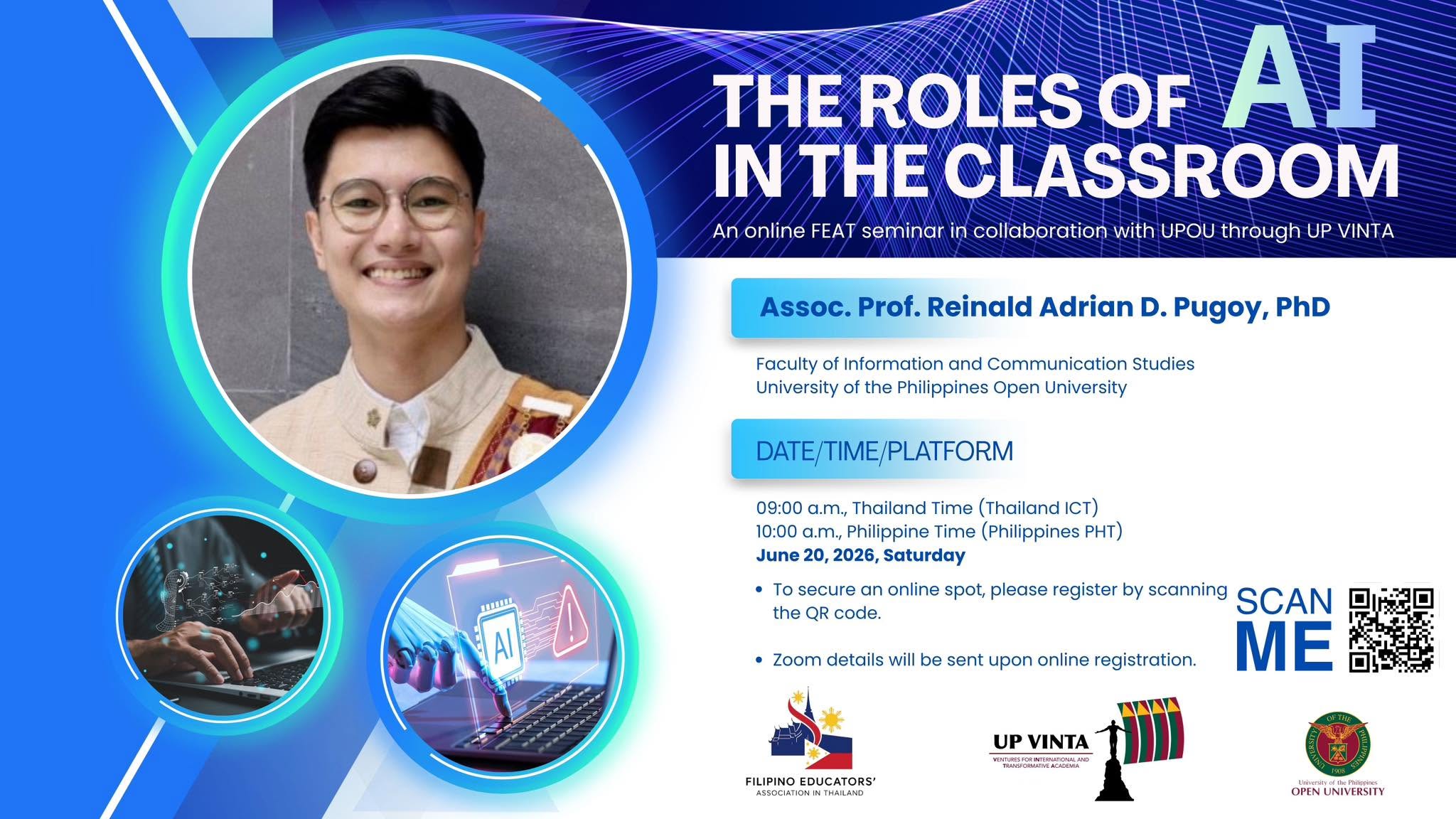
The event poster for the FEAT–UPOU webinar, “The Roles of AI in the Classroom.”
As its first collaborative undertaking, UPOU and FEAT conducted a webinar on “The Roles of Artificial Intelligence (AI) in the Classroom” on 20 June 2026 from 9:00 AM to 11:00 AM (Thailand) / 10:00 AM to 12:00 NN (Philippines). The webinar sought to increase educators’ awareness of the opportunities and challenges presented by artificial intelligence (AI) in education. It also aimed to equip participants with the knowledge and perspectives needed to critically and responsibly integrate AI tools into teaching and learning while reflecting on their capabilities and ethical implications.
Written by Mary Rose Alingasa | Edited by Lorena Jean Saludadez