



“As the days go by, AI is becoming more powerful, AI is becoming more ubiquitous, so it is incumbent upon us, fellow educators, that we know how AI works and how we integrate it into our teaching.”
This was the message emphasized by Associate Professor Reinald Adrian D. Pugoy, Director of the University of the Philippines Open University’s (UPOU) Information and Communication Technology Development Office (ICTDO), during the webinar “The Roles of Artificial Intelligence (AI) in the Classroom” held on 20 June 2026.
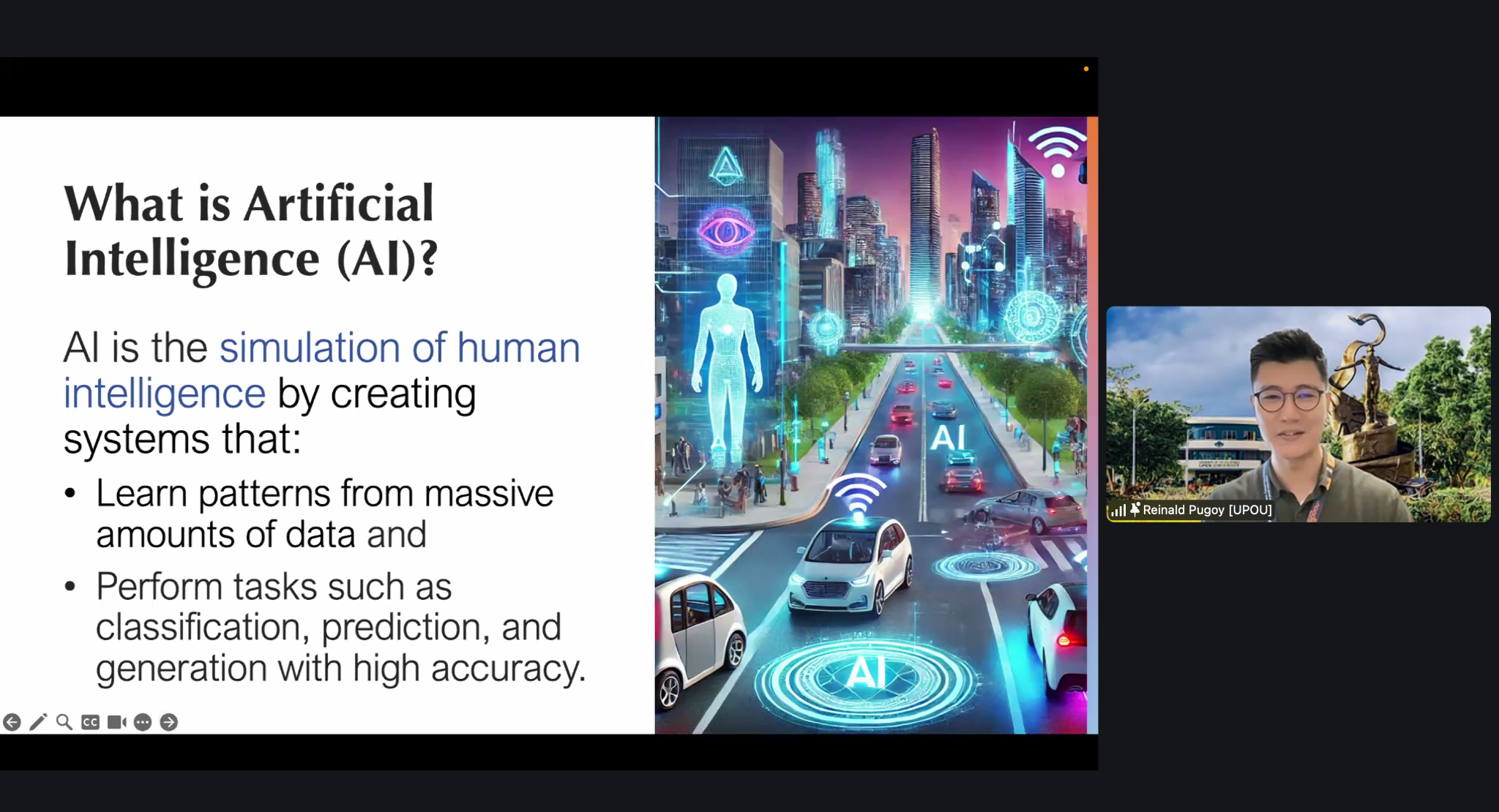
Assoc. Prof. Reinald Adrian D. Pugoy discusses the opportunities and challenges of integrating artificial intelligence into teaching and learning during the FEAT–UPOU webinar “The Roles of Artificial Intelligence (AI) in the Classroom.”
Conducted as the first collaborative undertaking between the Filipino Educators’ Association in Thailand (FEAT) and UPOU, the webinar gathered around 100 participants from various educational institutions and professional backgrounds across the Philippines and Thailand. The activity provided a venue for educators to explore the growing role of artificial intelligence in contemporary society and its implications for teaching and learning.
During the session, Assoc. Prof. Pugoy discussed how AI technologies are increasingly shaping everyday life and influencing the ways people work, communicate, and access information. He also examined the growing use of AI in educational settings, where these tools are becoming part of lesson preparation, content creation, assessment, and other teaching-related tasks.
While recognizing the potential of these technologies to support educators, he emphasized that their effective use requires thoughtful engagement and informed decision-making. According to Assoc. Prof. Pugoy, educators play a crucial role in helping learners understand not only how AI works but also how it can be used responsibly and meaningfully.
“We cannot really automate everything. We have to bring back everything that makes humans human,” he said, reminding participants that education ultimately remains a human endeavor shaped by judgment, creativity, and empathy.
The webinar concluded with an interactive Question-and-Answer session, during which participants raised questions on academic integrity, plagiarism, AI detection tools, the future of educational practice, and the integration of AI literacy into curricula. The discussion reflected the growing interest among educators in understanding how emerging technologies can be effectively integrated into learning environments.
In his closing message, Assoc. Prof. Pugoy encouraged participants to remain adaptable as technological change continues to reshape education. He left attendees with a reflective question: “How will you choose to adopt and adapt AI in your own context?”
As the inaugural activity under the FEAT–UPOU partnership, the webinar marked the beginning of a broader collaboration aimed at fostering professional development, knowledge exchange, and innovation among educators in the region.


Participants from the Philippines and Thailand joined the FEAT–UPOU webinar “The Roles of Artificial Intelligence (AI) in the Classroom,” held via Zoom on 20 June 2026.
Written by Mary Rose Alingasa | Edited by Lorena Jean Saludadez