
Imagine walking on rocky ground under the heat of the sun. You see rocks and stones scattered across the path. As your feet touch the ground, you feel its uneven texture. You instinctively raise your hand to protect your eyes from the sun’s glare. Your mind processes all this information without conscious thought. You either avoid the larger rocks or place your feet in ways that keep you stable. As a result, you are able to walk across the uneven ground without falling.
These sensory signals, in harmony with your body’s ability to position itself and move around, allows the body and the environment to be inseparable and mutually respond to each other. The body’s ability to sense and adjust its movements and positions is called proprioception.
Feeling the landscape
Seeking people’s perspectives on the landscapes they inhabit has long been a standard practice in developing plans and policies for environmental protection and landscape management. In the United Kingdom, for example, methodologies such as Landscape Character Assessment (LCA) have been used to capture people’s perceptions of an area and their sense of place.
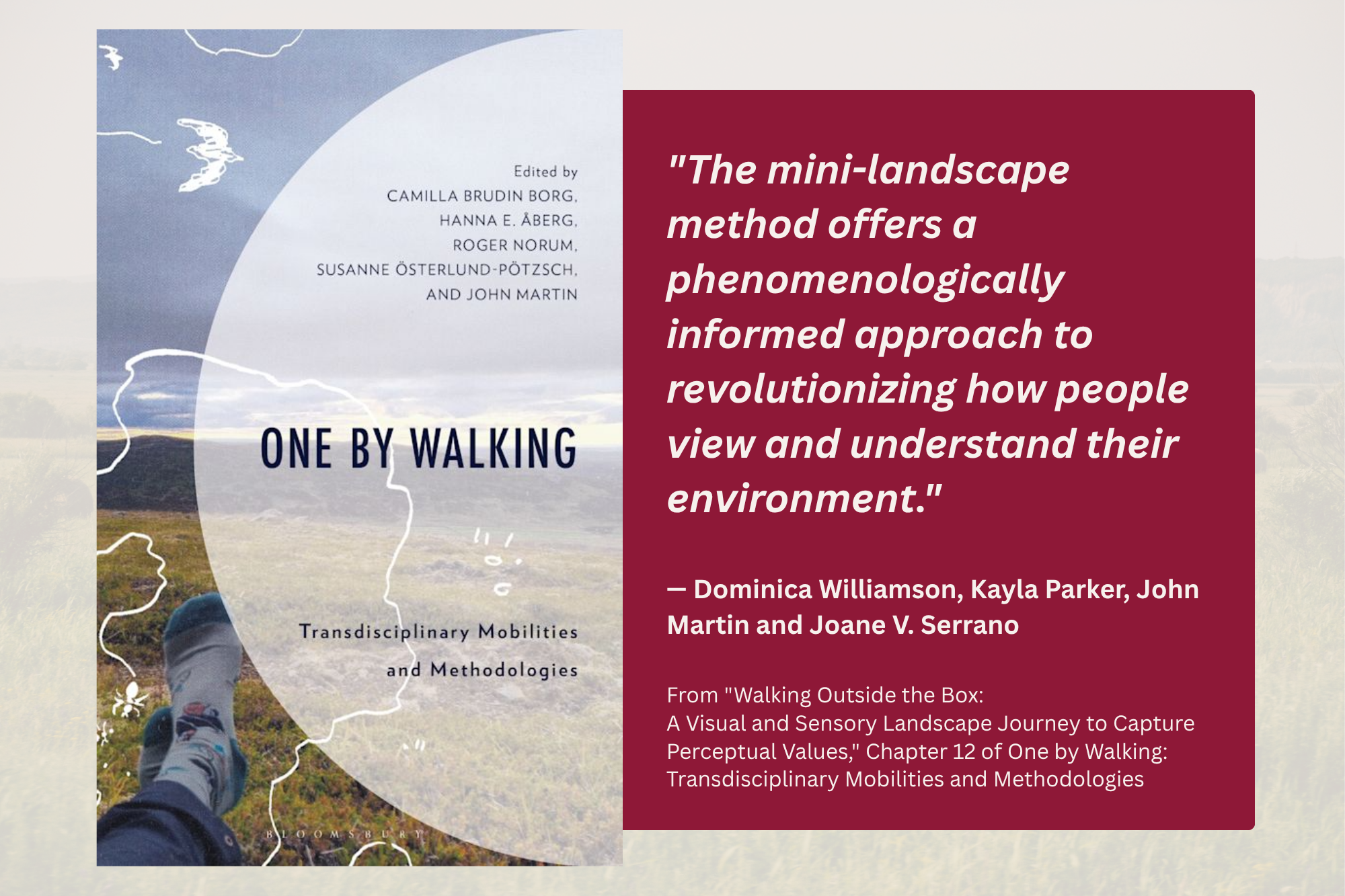
In the chapter “Walking Outside the Box: A Visual and Sensory Landscape Journey to Capture Perceptual Values” from the book One by Walking: Transdisciplinary Mobilities and Methodologies, published by Bloomsbury in 2026, authors Dominica Williamson, Kayla Parker, John Martin, and Joane Serrano assert that while these methods are relatively easy to implement and are motivated by a holistic perspective, they often fail to capture the complexities and nuances of people’s lived experiences of and within the landscape.
The authors emphasize that it is important for researchers and policymakers to understand how people “engage with landscapes on a tactile level, allowing them to explore not only the physical space but also their sensory and emotional connections to it.” Contrary to the conventional Western view, which separates the human observer from the landscape being observed, they propose that people do not merely interact with the natural world but rather “intra-act” within it by moving through it, feeling it, and conversing with it.
Landscapes are not static; they continually change as they are shaped by both natural processes and human activities. They also reveal themselves differently depending on the time of day, the season, the weather, and the movements of those who live in them. As a result, people’s perceptions of and emotional connections to a landscape are also constantly evolving. The authors argue that understanding a landscape, therefore, requires more than observing it from a distance. It requires living within it over time, allowing the body to experience its rhythmic and ever-changing nature.
This approach, known as the mini-landscape method, is grounded in indigenous peoples’ belief that humans exist in a “reciprocal relationship with nature, encompassing not only flora and fauna but also inanimate elements such as rivers and mountains.” It also aligns with indigenous knowledge systems across the Global South, where spirituality and the natural world are deeply intertwined and harmony between humans and nature is highly valued. As the authors note, many indigenous communities in the Philippines recognize “diwata” (nature spirits) and “anito” (ancestral spirits) as guardians of specific places and natural elements.
Mini-landscape methodology
The mini-landscape method is a participatory, immersive, and sensory-based activity designed to capture people’s sensory and emotional experiences of and within a landscape. It consists of three stages: embodiment of movement in which participants walk together; embodiment of tactile creation in which they create the mini-landscape; and embodiment of inscription in which they put their experiences into words.
In the first stage, participants walk side by side through a chosen landscape. Walking at a relaxed pace, they are encouraged to feel the trail beneath their feet, notice how their gait changes, experience the wind and the warmth of the sun, and become aware of how their bodies develop a relationship with the surrounding space through proprioception.
Using the natural and found materials they gather along the way, such as dried leaves, twigs, stones, and even trash, participants then create a miniature representation of the landscape. The mini-landscape may be arranged inside a vivarium (a glass enclosure) or directly on the ground in order to tell the story of the place.
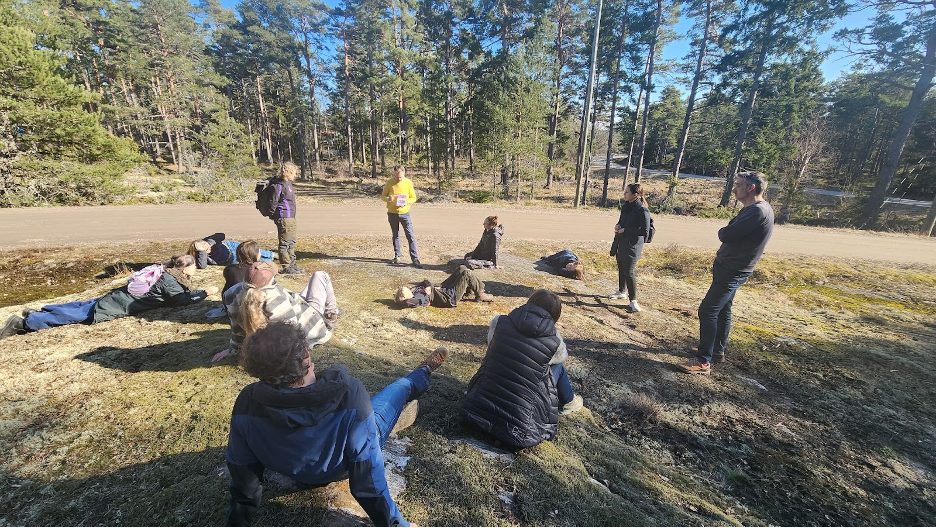
A walking methodology session during the Empathetic Trails workshop in Finland.
In the final stage, participants reflect on their sensory experiences, including touch, smell, taste, proprioception, and their overall emotions and feelings while moving through the landscape. They then write one or two words on small cards to express these reflections and place them within their mini-landscape.
This methodology has been developed through a series of workshops conducted over eight years in several locations, including the UK, several North European countries, Southern Italy, and the West Indian Ocean.
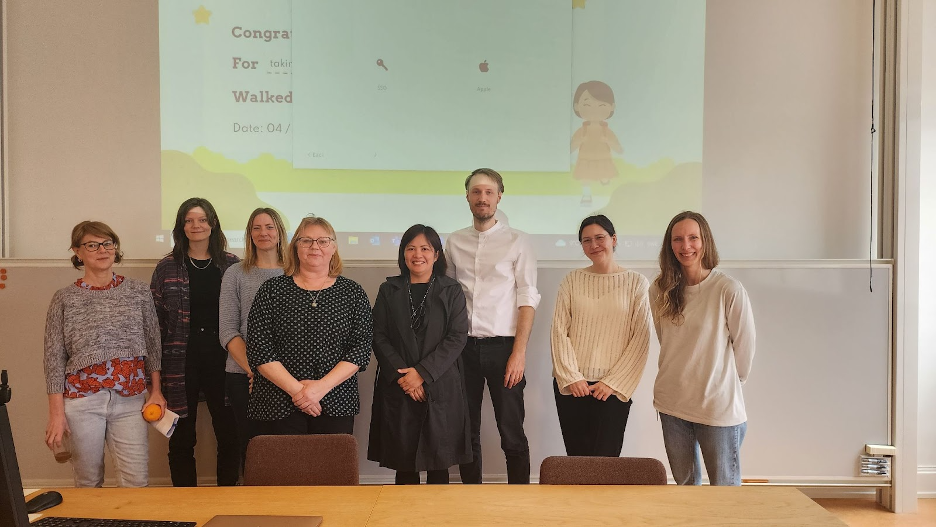
Dr. Joane V. Serrano (center), University of the Philippines Open University (UPOU) professor and co-author of the chapter, participated in the Empathetic Trails walking workshop in Finland and presented her research at the University of Gothenburg and the University of Plymouth in 2023.
The miniaturization of the landscape allows participants to create a multidimensional perspective of the landscape. It enables them to make their experience of nature tangible, reflect on the rhythms of nature that are normally left unspoken, and connect their personal stories with the landscape itself. All these help participants develop “a more integrated, ethical relationship with the environment” and view the landscape not as a fixed reality but as an interconnected system.
The perceptual data gathered through this methodology may appear “messy,” but they capture perspectives that conventional methods of analyzing landscapes often miss. The authors argue that addressing global environmental challenges requires a holistic approach that considers both the scientific and social dimensions of a place. Instead of treating landscapes as resources to be managed or exploited, this methodology encourages a more integrated relationship between people and nature. This is especially relevant in countries like the Philippines, where colonial legacies have marginalized indigenous knowledge systems and practices.
As this chapter recommends, the best way to understand nature is to be in it and walk through it. So the next time you have the chance to walk along a rocky path, beside a river, or even on a well trodden trail, pay attention to the wind against your skin, the warmth of the sun, the scents carried by the plants around you, and the way your body instinctively adjusts to the texture of the ground beneath your feet. That is your body in conversation with the landscape.
About the authors
Dr. Joane V. Serrano, professor of sustainability and current chancellor of the University of the Philippines Open University (UPOU), is among the co-authors of this chapter. She collaborated with Dominica Williamson, an independent artist and ecogeographer; Dr. Kayla Parker, an artist, filmmaker and academic at the University of Plymouth; and Dr. John Martin, a human geographer and head of research support and development at the University of Plymouth.
The chapter authors are members of the One by Walking, an international network that fosters collaboration, discussion, and experimentation on walking as a research methodology through scientific and arts based approaches.
Written by Primo Garcia | Visual layout by Marinela Hernandez