


How will AI reshape the future of student assessment? UPOU Vice Chancellor Aurora Lacaste and faculty members share their perspectives.
Generative artificial intelligence (AI) has disrupted teaching and learning by changing how learners access and interpret information and how they engage in academic tasks. While it can support idea generation, targeted information search, and editing, many in the education sector are concerned about its effects on students’ critical thinking and communication skills.
To determine how AI can be effectively and responsibly incorporated in assessment, the Office of the Vice Chancellor for Academic Affairs convened a Mini-Faculty Conference on 7–8 April 2026 for full-time faculty members to discuss challenges, identify integration points, and determine policy directions for the ethical and effective use of AI in assessment at UP Open University.
The conference drew from the experiences and perspectives of faculty members across disciplines. Vice Chancellor for Academic Affairs Aurora Lacaste explains, “Faculty members are at varying stages of AI integration – some are more open and experienced, others more cautious or still exploring its use – and this is good because diversity means there is something for everybody; all experiences and ideas are considered.”
Impressions from faculty members
Following the opening program, faculty members were interviewed about their impressions of AI’s role in assessment. Some faculty members view AI positively, while others remain more cautious about its use in assessment. For Asst. Prof. Regine Karla P. Bagalanon, Faculty of Management and Development Studies (FMDS), “AI democratizes access to high-quality, immediate, objective feedback on clinical reasoning.”
Asst. Prof. Dennis Lee Jarvis B. Ybañez, Faculty of Education (FED), “AI gives more time to focus on what matters most and be more creative.”
Asst. Prof. Edric Estrella, FMDS, noted that while AI aims to make assessment easier, educators still need to carefully review answers first to build a reliable reference framework that can later improve efficiency.
Meanwhile, Asst. Prof. Luisa Gelisan, Faculty of Information and Communication Studies (FICS), shared that AI-assisted assessment needs to be monitored due to the risk of hallucinations and possible inconsistencies with course rubrics.
Whether educators like it or not, Dr. Melinda Bandalaria of the FICS noted that the world of work is already integrating AI. She believes AI should be incorporated into learning activities and assessment as much as possible.
“It’s not just about facilitating tasks, but also about helping students develop the skills needed to cope with the demands of the workplace,” Dr. Bandalaria said.
Insights from the conference
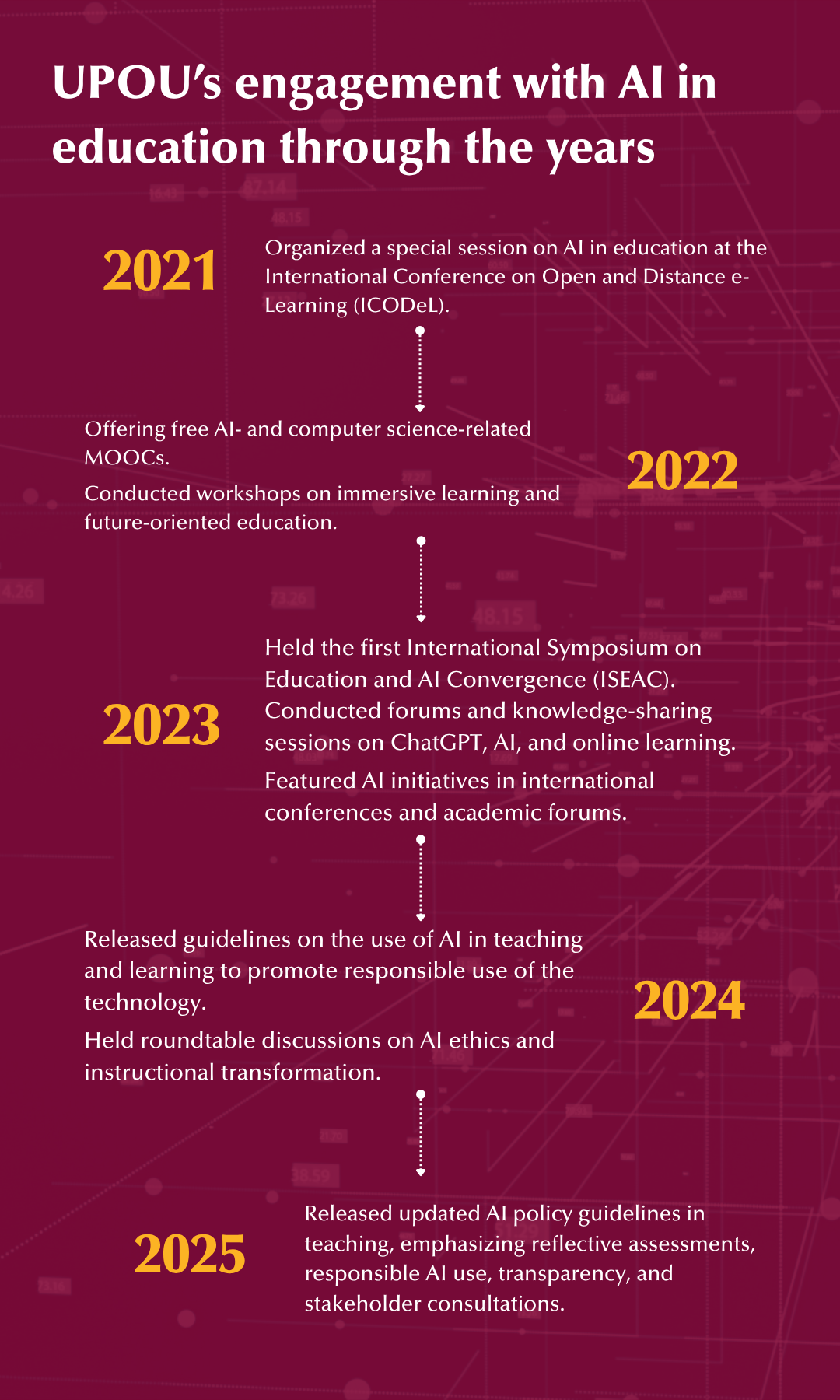
While UPOU had already developed its guidelines on the responsible use of AI in teaching and eLearning several years ago, Chancellor Joane V. Serrano emphasized that the conference was intended to encourage faculty members to revisit long-held assumptions about assessment and explore how AI can be integrated thoughtfully and responsibly into assessment practices.
Dr. Serrano explained, “The deeper purpose of this conference is not simply to respond to a technological trend. In the age of AI, we need to ask not only whether students can produce an answer, but whether they can understand, defend, apply, and responsibly use knowledge in context.”
The conference surfaced several insights and concerns not only about the role of AI in assessment, but also about the broader implications of AI in education. “A common concern raised was that AI may blur the boundaries of intellectual ownership and authentic work and unintentionally encourage dishonest practices among students,” Dr. Lacaste said. According to her, this raises questions about the value of graded assessments and the credibility of academic honors if the use of AI is not properly monitored or made transparent.
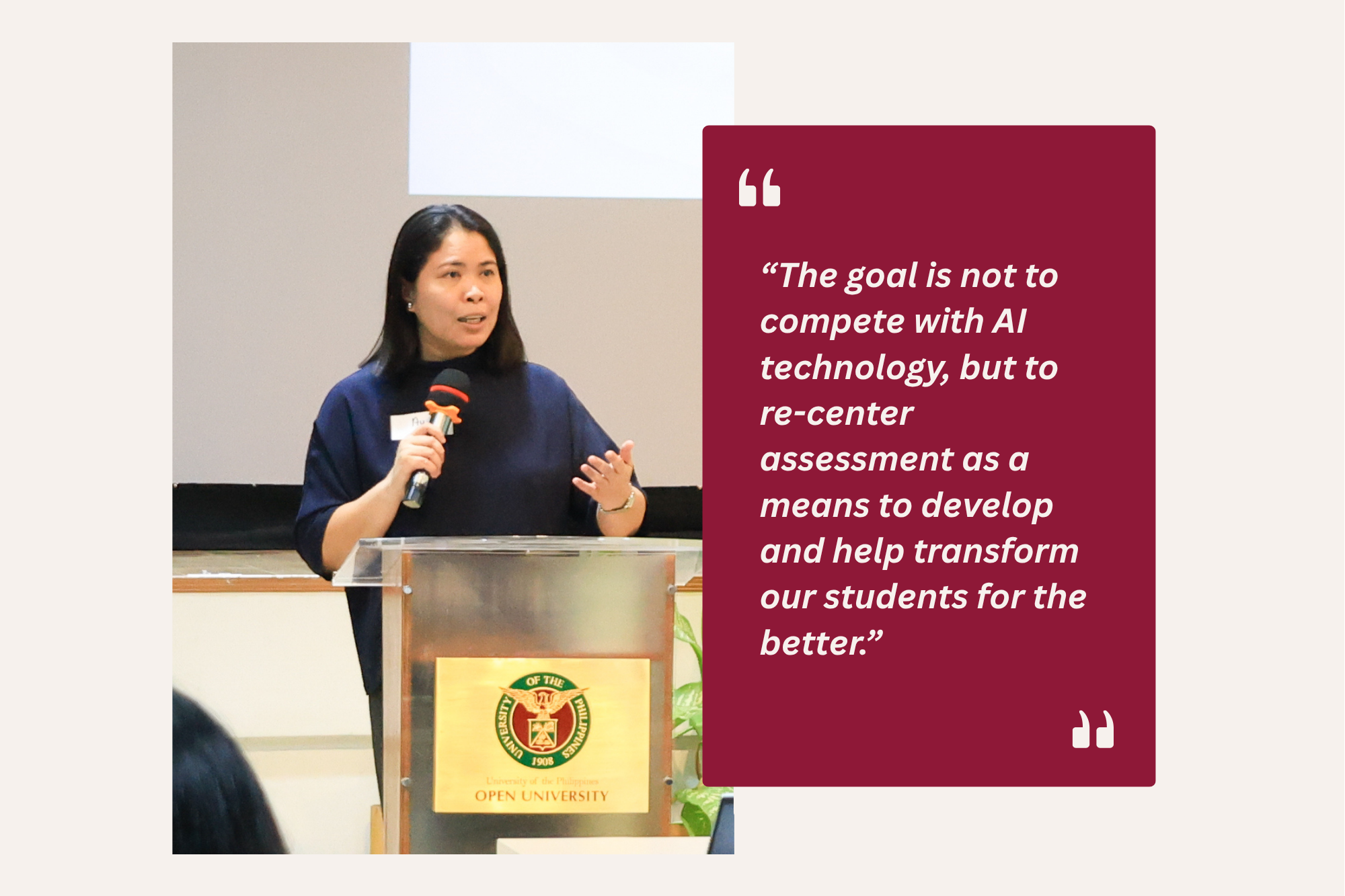
Dr. Aurora Lacaste, Vice Chancellor for Academic Affairs, shares her insights from the UPOU Mini-Faculty Conference on AI in Assessment.
She also added that AI challenges traditional assessment models that focus more on final outputs than the learning process, a view echoed in media discussions about the “death” of the college essay.
Faculty members also expressed concerns about the issue of unequal access to AI tools, which raises questions about equity and fairness in elearning. “Not all students have the same level of access to AI tools or have the same skills to use them effectively, which may create uneven advantages,” Dr. Lacaste said.
“In addition, overreliance on AI could limit opportunities for students to develop essential skills like critical thinking, creativity, and problem-solving.”
Teachers who use AI may also encounter similar concerns. Employing AI to design assessments while restricting students from using it in class can raise questions about fairness, double standards, academic honesty, and even creativity.
Vice Chancellor Lacaste believes that the conference enhanced faculty members’ understanding not only of the role of assessment but also of how it needs to evolve in response to developments in AI and other emerging technologies. Through a series of workshops, faculty members exchanged ideas on how to redesign their assessments and identify appropriate policies for incorporating AI into instruction.
While the conference explored how AI can be properly used in assessment, Dr. Lacaste shared that some faculty members viewed AI not just as a tool but as an agent. Unlike calculators and computers that mainly served as efficiency tools for learning, AI systems can exhibit characteristics such as memory, contextual awareness, and a degree of autonomy.
As Dr. Lacaste explained, “This shift in perspective was surprising because it moves the conversation toward a more complex understanding of how AI interacts with users and learning environments. I believe that there is a need for continued dialogue on this.”
Moving forward, her office will further synthesize the workshop discussions and recommendations to help inform the development of academic policies and teaching guidelines that can be integrated into course design, assessment strategies, and teaching guides.
AI reshaping assessments
With all the discussions on the affordances and downsides of AI in education, Dr. Lacaste foresees a shift from “heavy reliance on high-stakes, output-based assessments toward more progressive and process-oriented learning.” She believes that teachers in the University may make greater use of low-stakes formative assessments to better monitor and support students’ learning processes.
She also expects more teachers to adopt more authentic assessments that require students to reflect on and apply the lessons to their own personal or real-world contexts. More assessments will also require students to communicate with their peers inside and outside the course and engage in deeper and applied learning experiences. “These are harder to fully delegate to AI and, even better, make assessments more aligned with meaningful learning outcomes,” she added.
While some educational institutions lack a policy of AI or ban it entirely, Dr. Lacaste said that she sees the emergence of more nuanced and transparent guidelines on AI use at UPOU. She expects courses will increasingly define how and when AI can be used in class, and with some assessments requiring students to document and reflect on their use of AI tools as part of the learning process.
“AI will make us, as educators, more intentional, agile, and reflective in how we design assessment. The goal is not to compete with the technology, but to re-center assessment as a means to develop and help transform our students for the better,” she noted.
At the end of the day, Dr. Lacaste believes that technological innovation should advance academic excellence rather than undermine it. Academic excellence, she emphasized, should guide other forms of innovation.
“In the case of UP, ” she concluded, “this commitment is clearly expressed in its principle of honor and excellence in the service of the nation — an ideal that should shape how new technologies, including AI, are adopted in teaching and assessment.”
Written by Primo Garcia | Edited by Anna Canas-Llamas | Visual Layout by Marinela Hernandez