

The year 2020 is one of the most remarkable years in the history of education, especially in the Philippines. It was during the COVID-19 pandemic that higher education institutions transitioned from traditional classroom instruction to flexible learning (FL) to ensure the sustainability of education despite the world crisis.
When the COVID-19 pandemic disrupted classrooms across the globe, schools and universities faced a pressing question: How can education continue when students and teachers cannot be together in the same room?
For many institutions, the answer was FL—a blend of online, modular, and limited face-to-face instruction that allowed learning to continue despite unprecedented challenges. But as the world moves beyond the pandemic, another important question remains: Is FL here to stay?
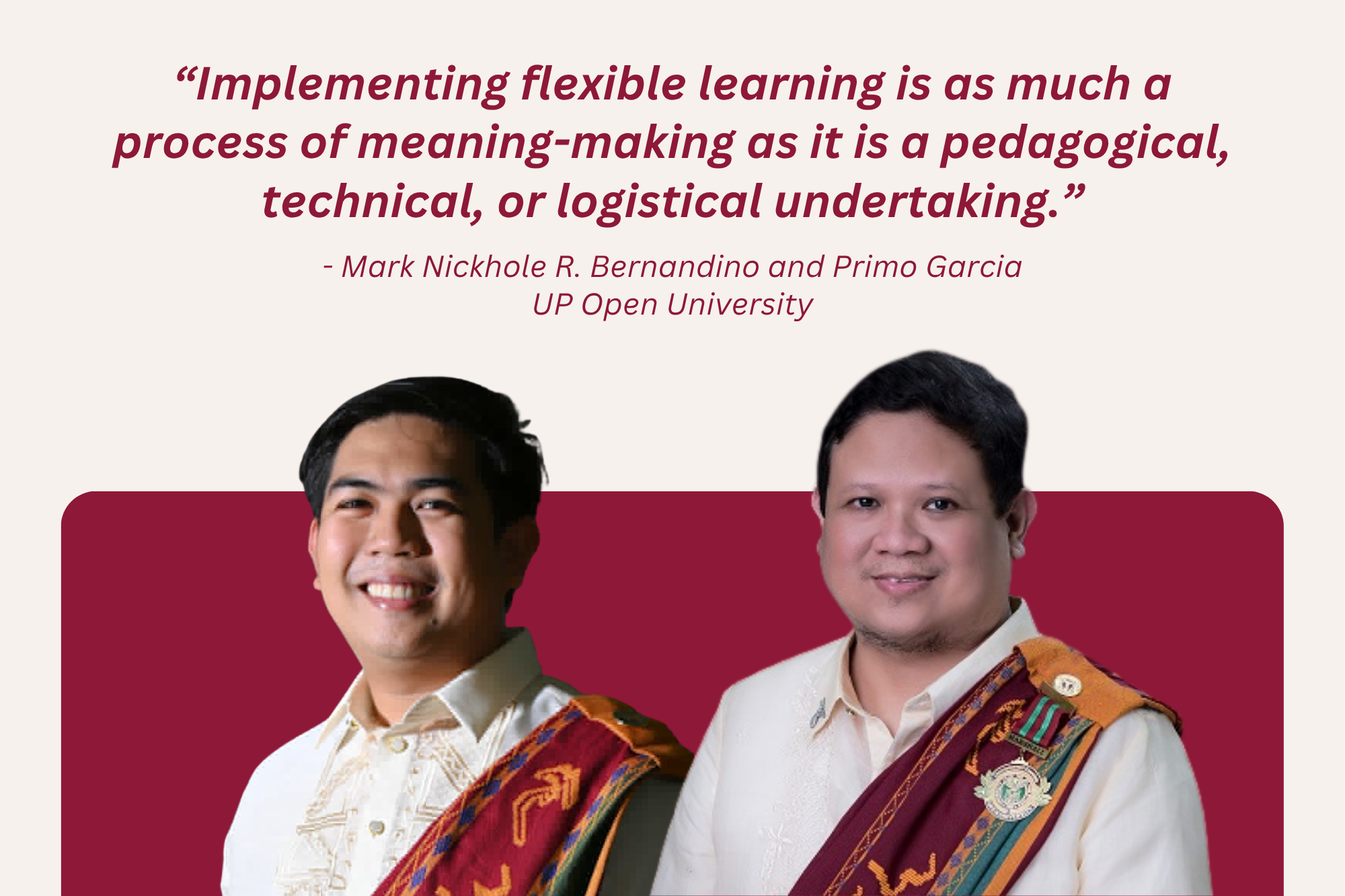
A published study titled “Access, Cost, and Quality in Flexible Learning: An Analysis of Institutional Perspectives Using the Iron Triangle Framework” by Mark Nickhole R. Bernandino, a graduate of UP Open University’s Master of Distance Education, and UPOU Professor Primo G. Garcia offers valuable insights into this question. Using a college that adopted FL during the pandemic as a case study, this research examined how institutional perspectives of FL shaped the implementation of flexible learning and the tensions among access, cost, and quality.
What flexible learning means
According to the study, faculty members, students, and administrators who participated in the study viewed FL as a combination of traditional and digital approaches, a product of the pandemic, and a potential means to attract new students.
One of the strongest findings of the study is that FL expands access to education. Students can learn from virtually anywhere, reducing transportation and relocation costs while allowing them to balance studies with work and family responsibilities.
Participants in the study noted that FL has the potential to attract more students, particularly adult and graduate learners who require greater flexibility in managing their schedules.
However, the study reveals that access alone is not enough. Respondents emphasized that effective implementation requires substantial institutional support, including investments in technology, faculty development, and digital infrastructure. They noted that both teachers and students need appropriate technical and pedagogical skills, while reliable access to technology remains essential for learners.
Faculty members also reported an increased workload associated with flexible learning, although many acknowledged that it has strengthened their digital competencies. Despite these benefits, participants observed that maintaining student motivation continues to be a challenge in flexible learning environments.
The research highlights a reality often overlooked: flexibility comes at a cost. Institutions must invest in digital infrastructure, faculty training, and support systems to ensure that educational quality is not compromised.
Dilemmas of flexible learning
To better understand these challenges, the researchers used Daniel’s Iron Triangle of Education framework, which argues that access, cost, and quality are interconnected. Improving one aspect often affects the others. For example, increasing access may require additional institutional investments, while reducing costs may have implications for educational quality.
The study identified three major tensions in FL: greater student access versus lower student motivation; improved faculty digital skills versus increased workload; and lower costs for students versus higher institutional spending on technology and support systems.
The most visible advantage of flexible learning is its ability to make education more accessible. Students no longer need to relocate or commute to attend classes. Working professionals, parents, and learners from geographically distant areas can participate in higher education while maintaining their personal and professional responsibilities.
However, this same flexibility can become a double-edged sword for the first tension. Several participants shared that online environments often lead to procrastination and reduced engagement. Without the structure of a physical classroom, some students found it difficult to stay motivated, pay attention during classes, or complete tasks promptly. The challenge becomes even greater for courses requiring hands-on or laboratory activities, where learning by doing is essential.
In other words, while flexible learning removes barriers to entering the classroom, it does not automatically guarantee meaningful learning experiences. Increased access must be accompanied by strategies that promote student engagement, timely feedback, and learner support.
The tension of improved faculty digital skills versus increased workload reveals an important lesson: technology alone does not transform education, people do. The study found that teachers became more technologically proficient as they learned to use videoconferencing tools, learning management systems, and other digital platforms. Many educators reported becoming more creative and confident in integrating technology into their teaching practices. For some, flexible learning served as an opportunity for professional growth.
Yet these gains came at a significant cost. Faculty members had to redesign syllabi, revise modules, prepare digital learning materials, manage online classes, and provide virtual support to students. For educators who were less familiar with technology, the transition was particularly demanding. Administrators also noted the difficulties experienced by teachers accustomed to traditional classroom instruction.
With this, institutions must invest not only in digital tools but also in faculty development, mentoring programs, and policies that promote teacher well-being.
Flexible learning can significantly reduce educational expenses for students. Participants cited savings on transportation, accommodation, and daily commuting costs. However, the study found that these savings often shift costs to educational institutions.
Making flexible learning work beyond the pandemic
To successfully implement flexible learning, the authors said that universities must invest in internet infrastructure, digital platforms, technical support, cybersecurity, learning management systems, and faculty training programs. Institutions also need to provide ongoing support to both students and faculty to ensure educational quality. They need to establish policies that support the adoption, development, and delivery of flexible courses.
However, most of these initiatives designed for effective FL implementation are often ignored. The study suggests that the college had not fully implemented these measures at that time, as FL was viewed “primarily as a product of the pandemic – an emergency response to a public health crisis rather than a long-term educational strategy.”
These findings underscore that FL is not simply about moving classes online. It requires thoughtful planning, continuous investment, and a shared understanding among students, educators, and administrators. For institutions engaged in it, the study carries an important message: how faculty members, students, and administrators view FL influences the extent to which they are willing to address these tensions among access, quality, and cost.
As the authors said, “implementing FL is as much a process of meaning-making as it is a pedagogical, technical, or logistical undertaking.”
Written and Visual Layout by Marinela Hernandez | Edited by Anna Cañas-Llamas