As futurist Alvin Toffler (1928–2016) once said, “technology is a great growling engine of change.” This observation is clearly evident in education, which, in the last few years, has seen the adoption of a wide array of new technologies, from interactive applications to artificial intelligence systems. But what kinds of technologies do students really want?
A recent study explored this question by surveying 250 students from five different online universities in Southeast Asia about the new features they prefer in their learning management system.
Working under the collaborative research program of OU5, the study team was composed of Roberto Bacani Figueroa, Jr., and Luisa Almeda Gelisan, UP Open University (UPOU); Mai Huong Nguyen, Hanoi Open University (HOU); Aliza Ali, Open University Malaysia (OUM); Lugsamee Nuamthanom Kimura, Sukhothai Thammathirat Open University, Thailand (STOU); and Marisa Marisa and Ami Hibatul Jameel, Universitas Terbuka, Indonesia (UT).

Dr. Figueroa (standing, far right), with the OU5 Research Team.
What Students Want
Overall, the study revealed that the most preferred features were interactive books, grade prediction, and course suggestions. Most students want digital textbooks with engaging elements like videos, quizzes, and other interactive features. They prefer not just to read but also to engage with learning resources in different ways. They also favor smart learning tools like grade prediction and course suggestions, which could help them track their progress and choose the right courses to take, given their profile.
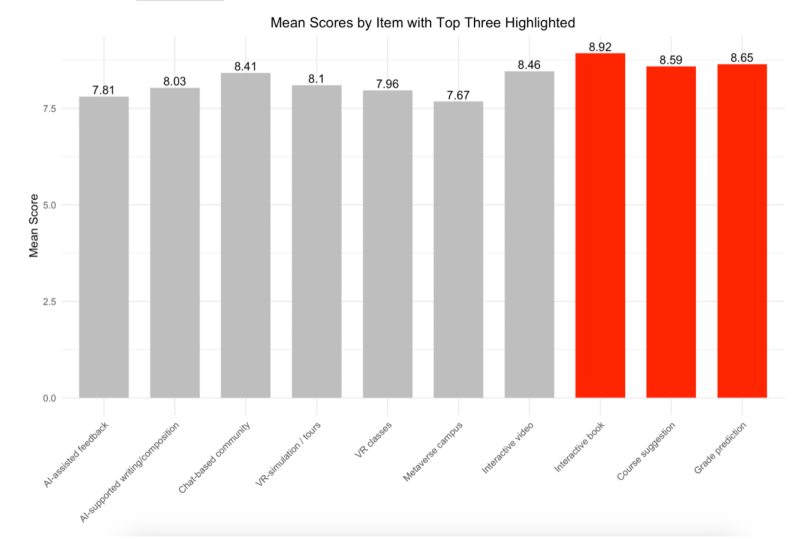
Average Ratings of Desired LMS Features by Learners. (Source: https://arxiv.org/pdf/2506.00922)
In addition, they also highlighted the importance of timely feedback and interactivity. Feedback allows them to monitor their progress and improve on their academic performance in real time.
Games, simulations, and virtual spaces help learning be more collaborative and fun. More conventional online tools like discussion forums are also seen as useful for engaging students and making online learning feel less distant.
Variations Across Universities
While the students appreciate the role of technologies in learning, their preferences differ across universities. For example, students from UT, STOU, and UPOU were generally more interested in AI-assisted writing and feedback. Students from UT showed greater interest in VR simulations and classes compared to students from UPOU. In terms of interactive book features, UPOU significantly preferred them more than their counterparts in HOU and OUM.
What it Means for Universities
The study contributes to current debates on the role of emerging technologies in enhancing learning experience. It also highlights the importance of context in integrating technologies in instruction, showing that a one-size-fits-all approach may not work. However, the authors also note that the preferences may indicate response bias, as students tend to prioritize features that they are already familiar with and find useful.
Nevertheless, the study provides educational institutions with valuable insights on prioritizing the technologies for teaching and learning based on their specific context. As the authors concluded, “mainstreaming these technologies should focus on enhancing students’ engagement, fostering active learning, and providing personalized data-driven learning experiences that cater to the different learning styles and diverse needs of students.”
For educators, the growing range of technologies has opened up more opportunities to support teaching and learning. Ultimately, the technology’s effectiveness will depend on how well it helps students learn more effectively.
Written by Primo G. Garcia | Edited by Roberto B. Figueroa, Jr. and Anna Cañas-Llamas | Photos from Roberto B. Figueroa, Jr.