UPOU’s Center for Open and Digital Learning (CODTL) advances open and distance e-learning (ODeL) through training, research, and open knowledge initiatives that strengthen inclusive and flexible online education. As part of Open Education Month, we spoke with its officials to learn more about how the Center is supporting sustainable and future-ready digital education.
As they say, effective learning does not happen by chance. This is especially true in open and distance e-learning (ODeL), where students are separated from their teachers by time and space, and interaction is mediated by technology. For online teaching to be sustainable, teachers must be supported with strong pedagogical skills, assisted in producing learning materials and using educational technologies, and engaged in continuous learning of emerging approaches.
Since its establishment, UP Open university (UPOU) has consistently provided academic support to its faculty members for this multifaceted task of teaching online. With the reorganization of the Office of Academic Support and Instructional Services (OASIS) and the Multimedia Center into the Center for Open and Digital Learning (CODTL) in 2023, UPOU is poised to further strengthen these support services in light of a changing educational landscape driven by technological advances, shifting professional requirements, and new insights from open learning research.
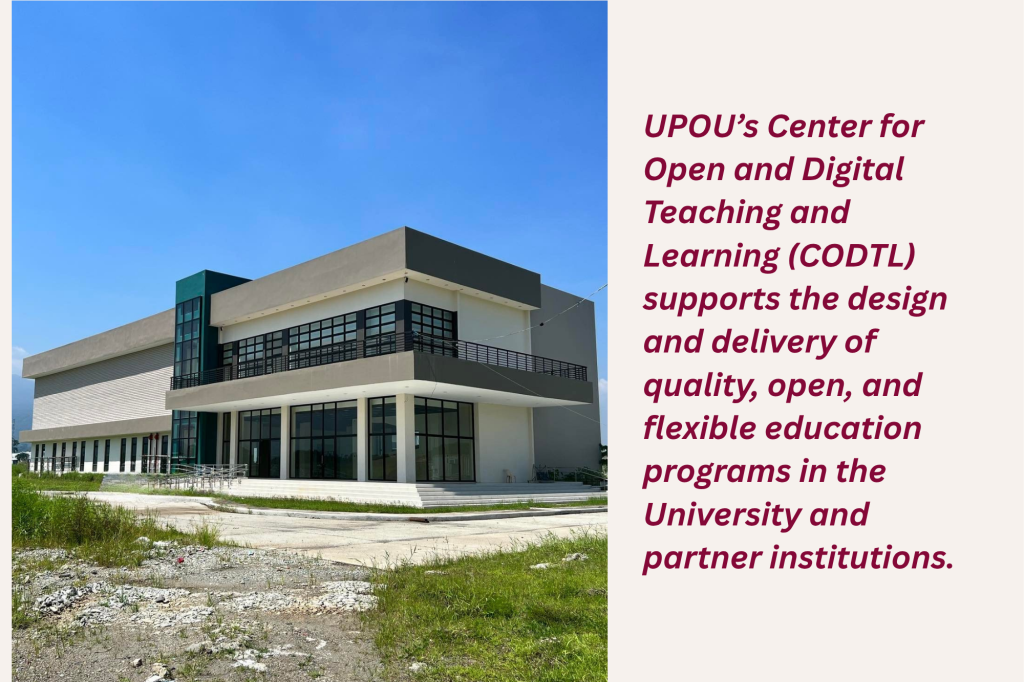
As part of UPOU’s 31st anniversary program, CODTL announced its new initiatives, including the establishment of an ODeL teacher professional certification, the enhancement of UPOU Networks, and the publication of a special issue in the International Journal of Open and Distance eLearning.
Equipping ODeL Teachers
CODTL will introduce a tiered certification program to train faculty members not only from UPOU but also from other HEIs. The training aims to develop teaching competencies such as structuring online courses, selecting appropriate online learning resources, designing meaningful learning activities, and creating authentic assessments suitable for an online learning environment.
“One of the key features of the program is its hands-on approach where it is more focused on applied and design-focused training rather than understanding the foundational concepts,” said Dr. Joseph De Mesa, CODTL’s Deputy Director for Learning Design.
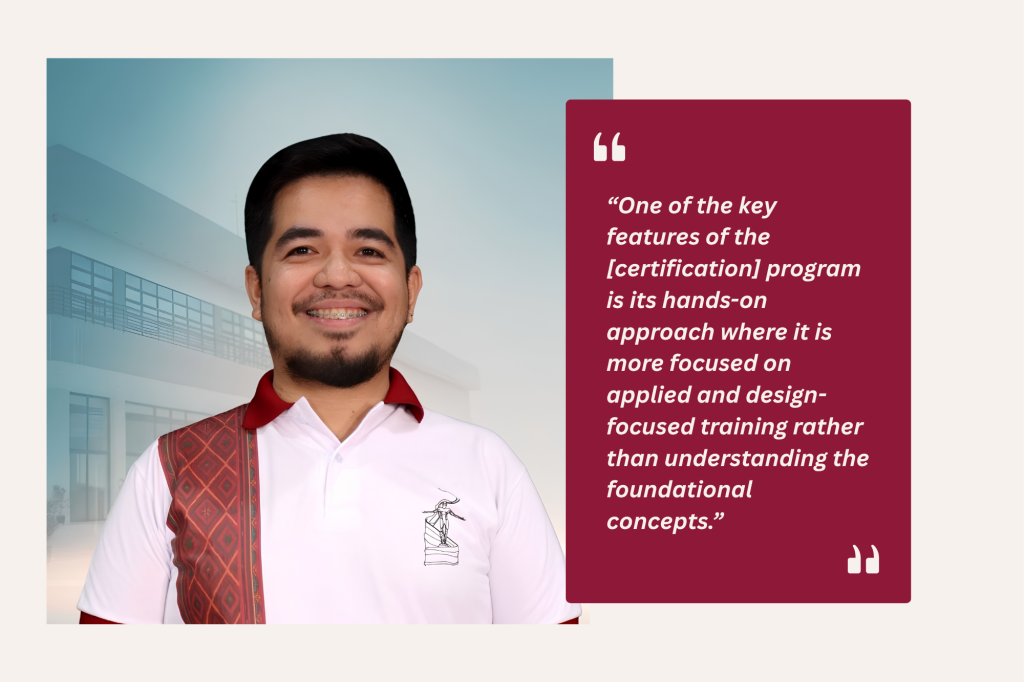
Dr. Joseph de Mesa is the Deputy Director for Learning Design, CODTL
The program has been redesigned into three phases. First is online onboarding, where teachers are introduced to the ODeL frameworks. Second is asynchronous online learning, where they experience what it is like to be a UPOU student. The program then concludes with a face-to-face, two-day intensive workshop, where they practice their skills in designing high-quality courses suitable for guided independent online learning.
In addition, the courses will also be offered to faculty members of other higher education institutions as part of UPOU’s mandate to capacitate other universities in open and distance learning, as provided for in Republic Act 10650.
“We are receiving an increasing number of requests from other HEIs, whether for institutional training, consultancy, or benchmarking. We are really seeing growing demand as other HEIs transition to more flexible online learning environments,” the official said.
The certification program, which will be made available to other HEIs beginning midyear, will complement UPOU’s massive open online courses (MOOC), which provide foundational awareness on ODeL. The MOOCs serve as an entry point, after which faculty from other universities can proceed to the more advanced certification program.
“The course will open in June, and anyone can participate as long as they are part of HEIs or even local government units. They can simply access the program by registering online, with details to be published soon,” said Dr. de Mesa.
Making educational resources more accessible
As part of its open knowledge initiatives, UPOU has established the UPOU Networks as its official online knowledge-sharing and content platform, where open educational resources are made accessible to faculty members, students, and the general public.
“Most of the resources published in our UPOU Networks are under a Creative Commons license, meaning they are open to everybody. You can utilize them, reuse them, or modify them, depending on the license,” said Dr. Benigno Agapito Jr., Deputy Director for Educational Media Production (EMP).
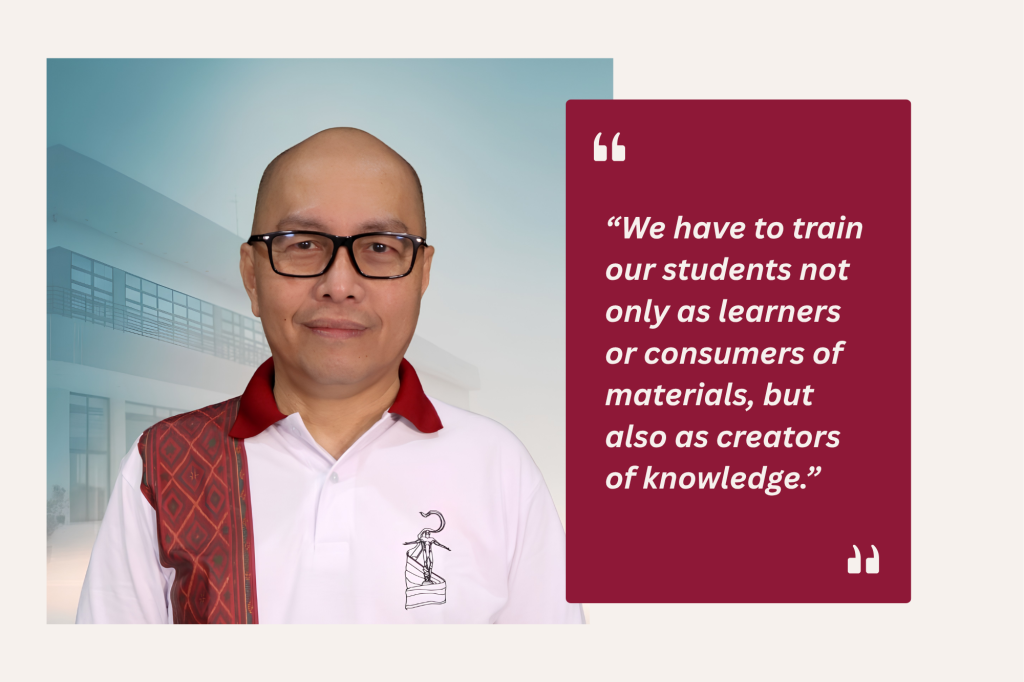
Dr. Benigno B. Agapito Jr. is the Deputy Director for Educational Media Production, CODTL
After reviewing the platform, CODTL has made decisions to better align it with the university’s open education mandate. To improve accessibility, the platform is currently being redeveloped to enhance navigation and metadata tagging.
CODTL is also developing guidelines to strengthen the center’s capacity to produce resources aligned with international quality standards. “Our objective is not only for the OER to be used internally by UPOU, but also by other HEIs as well as non-formal education institutions like TESDA. We want it to be globally competitive so that other universities can also access it.”
The Center also intends to expand the range of video materials to include micro video lectures, explainers, and mini-documentaries.
In support of open educational practice, CODTL is also opening the Networks to student-generated content. It is preparing guidelines for reviewing and curating student work for publication on the platform. This is expected to encourage faculty members to use multimedia as a format for course requirements, making these outputs more accessible to other learners in the future.
As Dr. Agapito explained, “We want to develop them not just as learners, but as co-creators of knowledge. We have to train our students not only as learners or consumers of materials, but also as creators of knowledge.”
Disseminating ODeL research
Another important function of CODTL is to conduct research to evaluate the effectiveness of the learning approaches it implements, as well as to examine emerging educational designs. It is also mandated to share its research-based educational practices through publications.
In support of this mandate, CODTL is publishing research articles that demonstrate innovative online learning designs. This special issue, under the guest editorship of CODTL Director Juvy Lizette Gervacio and Universiti Kebangsaan Malaysia (UKM) Associate Professor Helmi Norman, features contributions from Asia, Europe, and Africa that highlight pedagogies and the use of digital tools for inclusive and meaningful learning.
“It will touch on emerging technologies, intentional instructional design, and, more importantly, reflective practices for learning, community engagement, and distributed and online environments,” said Dr. Juliet Aleta Villanueva, Deputy Director for ODTL Research and Evaluation.
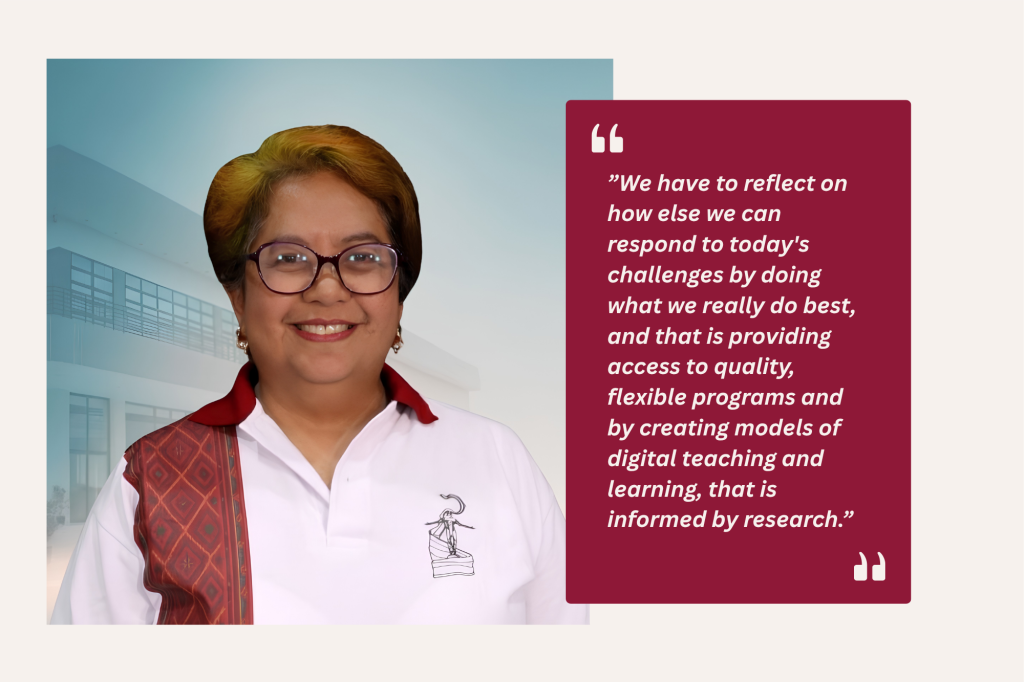
Dr. Juliet Aleta R. Villanueva is the Deputy Director for Open and Digital Learning Research, CODTL
CODTL is currently laying the groundwork for a study on varied learning designs and OER development to enhance online student engagement, particularly among marginalized sectors. In the immediate future, it will conduct policy research on capacity building and quality assurance in digital teaching and learning environments. It also plans to publish an open book series documenting UPOU’s practices in online teaching, course design, and instructional innovation, which could also serve as a practical reference for other HEIs transitioning to flexible learning programs.
Dr. Villanueva believes that these research articles are good reminders that UPOU has come a long way since the ODeL concept was articulated by former UPOU Chancellor Grace Alfonso.”With that, I think we have to reflect on how else we can respond to today’s challenges by doing what we really do best, and that is providing access to quality, flexible programs and by creating models of digital teaching and learning, that is informed by research,” she concluded.
Adapting to shifting educational landscape
Technological innovations such as generative artificial intelligence (AI) are expected to reshape how students learn and how educators teach. Five years from now, Center Director Gervacio believes that students entering higher education are likely to be AI users. “We hope that our educators are able to keep up and learn how it can be used,” she said.
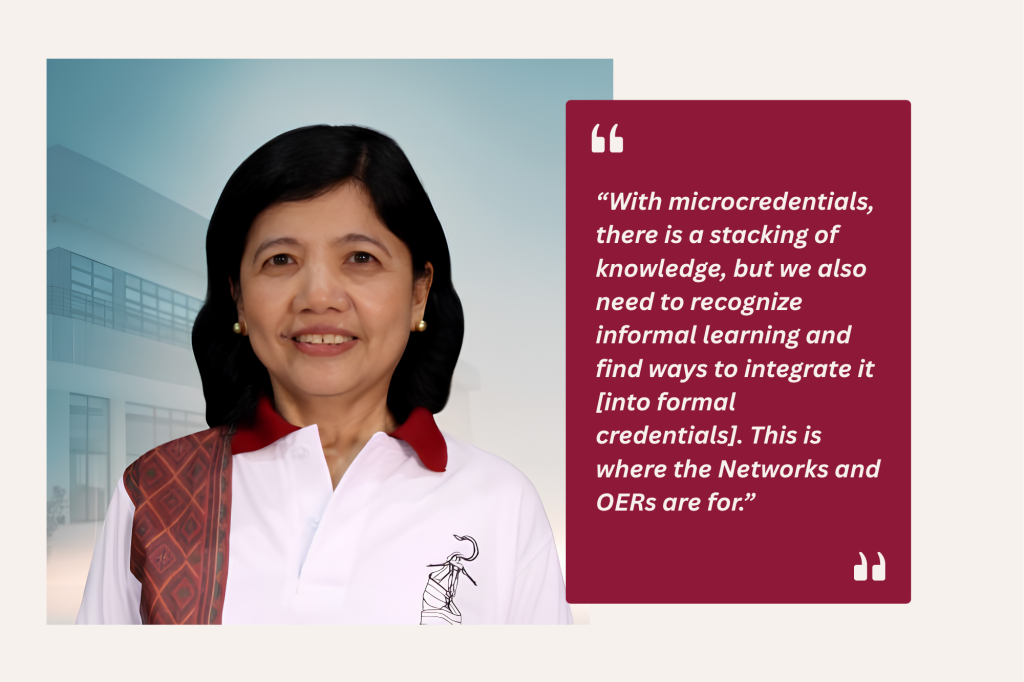
Dr. Juvy Lizette Gervacio is the Director of the Center for Open and Digital Teaching and Learning (CODTL).
It is the role of the university to reskill and upskill its faculty members in the ethical and intentional use of AI. “That’s why we are incorporating AI into our training programs so that our educators will be able to effectively integrate it into online learning,” she said. This initiative is in line with the current UPOU administration’s thrust to develop policy guidelines on the effective use of AI in assessments.
In addition to disruptions caused by new technologies, the sustainability of education is another concern that educational institutions must address. With the increasing popularity of microcredentials, Dr. Gervacio believes that learning pathways between non-formal, informal, and formal learning need to be clearly defined.
“I see that in online teaching and learning, there will now be a closer interconnectedness between these three. With microcredentials, there is a stacking of knowledge, but we also need to recognize informal learning and find ways to integrate it [into formal credentials. This is where the UPOU Networks and OERs are for.” CODTL sees the UPOU Networks as a platform for connecting the informal and formal elearning spaces.
Dr. Gervacio also highlighted the need to recognize community learning, which can also be facilitated online. This approach dovetails with CODTL’s plan to expand its capacity-building initiatives for other institutions.
“A lot of HEIs—not only HEIs, but also government agencies—are interested in developing their informal learning or MOOCs platforms. After the COVID-19 pandemic, many also realized the significant potential of digital learning.”
In capacitating these organizations, CODTL envisions a future where various communities can be reached through a network of cooperating institutions. “We have a community of learners who can really make education more meaningful, and it is now the role of the university to balance these kinds of strategies for education.”
Many of the initiatives launched by CODTL “are not really new. But we can say we have energized them in a way that they are revamped and updated.”
Building on these continuing efforts, UPOU has maintained its long-standing commitment to ensuring that ODeL remains not only inclusive but also effective—from the establishment of OASIS in 1996 and the Multimedia Center in 2004, to the formation of CODTL today. In pursuing and upholding these initiatives, CODTL continues to advance its mission by harnessing technology and upholding the values of open learning, while overcoming distance barriers to make quality education more accessible to all.
Written by Primo Garcia | Edited by Anna Canas-Llamas | Visual layout by Marinela Hernandez