The University of the Philippines Open University (UPOU) continued its efforts to promote sustainable development by participating in the University of the Philippines (UP) Strategic Conference on Sustainable Development, held from 18 to 20 November 2025, at the ibis Styles Manila Araneta City in Cubao, Quezon City. With the theme “Sustainable Development as a Nexus of Transformation,” the conference highlights the University of the Philippines’ vision of being a “Transformative University in the Service of the Nation.”
Hosted by the UP-Centre International de Formation des Autorités et Leaders (UP-CIFAL Philippines), it follows a system-wide effort initiated in December 2024 to strategically assess the preparedness, engagement, and awareness of UP’s eight Constituent Universities (CUs) and one Autonomous College in contributing to the Sustainable Development Goals (SDGs).
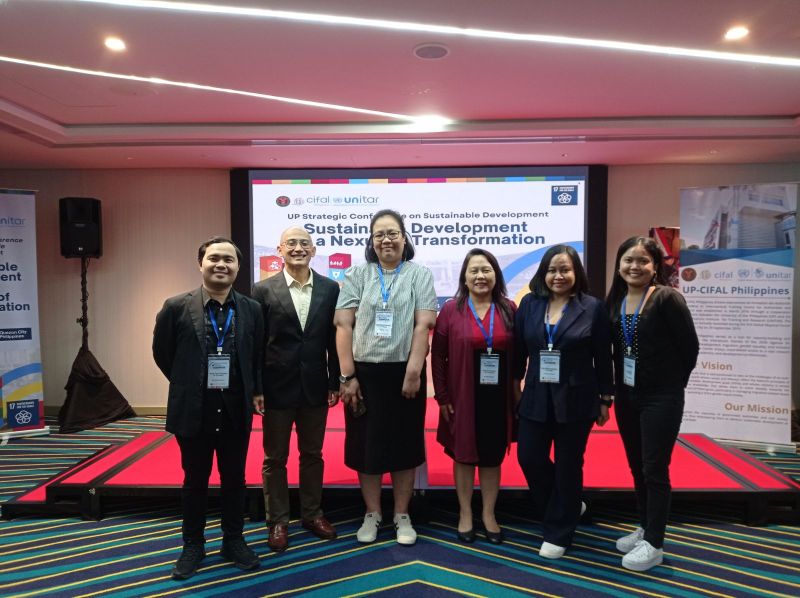
(L-R) Asst. Prof. Remsce Pasahol, Asst. Prof. Karl Villegas, Dr. Charisse Reyes, Asst. Prof. Emely Amoloza, Ms. Almira Andin and Ms. Maelyn Pisueña at the UP Strategic Conference on Sustainable Development. Photo courtesy of Maelyn Pisueña.
Six delegates from the University of the Philippines Open University (UPOU) participated to share valuable insights and best practices in contributing to the Sustainable Development Goals (SDGs).
On the first day, Asst. Prof. Remsce A. Pasahol from the Faculty of Management and Development Studies (FMDS) presented a project titled “PAMAYANAN: An Urban Planning Studio for Co-Creating Sustainable Cities and Communities.” Following this presentation, an open forum was held, moderated by Dr. Charisse T. Reyes, Dean of the Faculty of Education and Ms. Almira Nerissa A. Andin, a Doctor in Sustainability student, together with Asst. Prof. Crina Tañongon from UP Cebu during an open forum following the first set of CU presentations.
The second day featured Asst. Prof. Karl Abelard Edberto L. Villegas, also from the FMDS, who discussed the “UPOU-EDC BINHI Native Forest Arboretum: A Living Laboratory for Climate Resilience and Ecosystem Restoration.”
Other notable participants included Prof. Ricardo T. Bagarinao, the UPOU SDG Focal Point Person, Asst. Prof. Emely M. Amoloza from the Faculty of Information and Communication Studies, and Ms. Maelyn V. Pisueña, a Senior Technical Staff Member of the UPOU SDG Committee.
The conference also featured keynote presentations from notable speakers, Dr. Shepherd Urenje, Dr. Nathaniel Bantayan, and Dr. Brodie Beales, who discussed transformative approaches to education, the sustainability framework and initiatives of UP Los Baños, and the shared responsibility of institutions and communities in advancing sustainable development, respectively.
On the last day of the conference, delegates from all CUs gathered for a workshop to discuss and provide feedback on the draft One UP SDG Framework, which aims to guide the integration of sustainability across the UP System’s teaching, research, and public service functions.
UPOU representatives, Ms. Andin, Asst. Prof. Reyes, Asst. Prof. Amoloza, Asst. Prof. Villegas, Ms. Pisueña, and Asst. Prof. Pasahol met onsite and conferred with Prof. Bagarinao, who joined the workshop online via Zoom.

UPOU delegates during the workshop segment of the UP Strategic Conference on Sustainable Development. Photo courtesy of Maelyn Pisueña.
The three-day conference featured presentations structured around two crucial frameworks. First, the Pillars of the 17 SDGs, which represent a universal call to action to ensure holistic development. Second, the UP Strategic Plan 2023-2029, which highlights the university’s focus areas, including Teaching, Research, Innovation and Creative Work; Public Service; and Consultative and Accountable Governance.
The conference also encouraged the sharing of knowledge and best practices among the CUs, bolstering UP’s leading role in sustainable development in the Philippines and fostering synergy and collaboration.
UPOU’s participation highlights UP’s recognition of the importance of collaborating with various stakeholders within the Quadruple Helix, which includes governments, industries, and societal groups, to promote progress and sustainable development.
The resources needed to implement the Agenda are addressed through the Partnership pillar (SDG # 17). This approach aligns with UP’s sixth Flagship Program, which focuses on Active and Collaborative Partnerships to foster inclusive development.
Written by Maelyn V. Pisueña and Angelo Joaquin Ascan | Edited by Primo Garcia, Ricardo Bagarinao and Anna Cañas-Llamas | Photo Courtesy of Maelyn V. Pisueña