



In recent years, there has been increasing emphasis on innovation across all sectors of society. Innovation has been touted as the ultimate key to national competitiveness and development. But what really is innovation? Is it an idea, a process, or an outcome?
These are some of the questions explored in a published research article by Raymond Calbay and Jean Saludadez that examines how innovation is created through the founding stories of tech startups.
Dr. Calbay is a Doctor of Communication graduate of the University of the Philippines Open University (UPOU), an Associate Professorial Lecturer at Mapua University, and an affiliate member of the UPOU FICS Decentered Human Communication Research Group.
Dr. Saludadez is a Professor at UPOU’s Faculty of Information and Communication Studies. An active researcher in the Montreal school of organization communication, she has studied the communicative constitution of organizations (CCO) alongside University of Montreal-based researcher Francois Cooren.
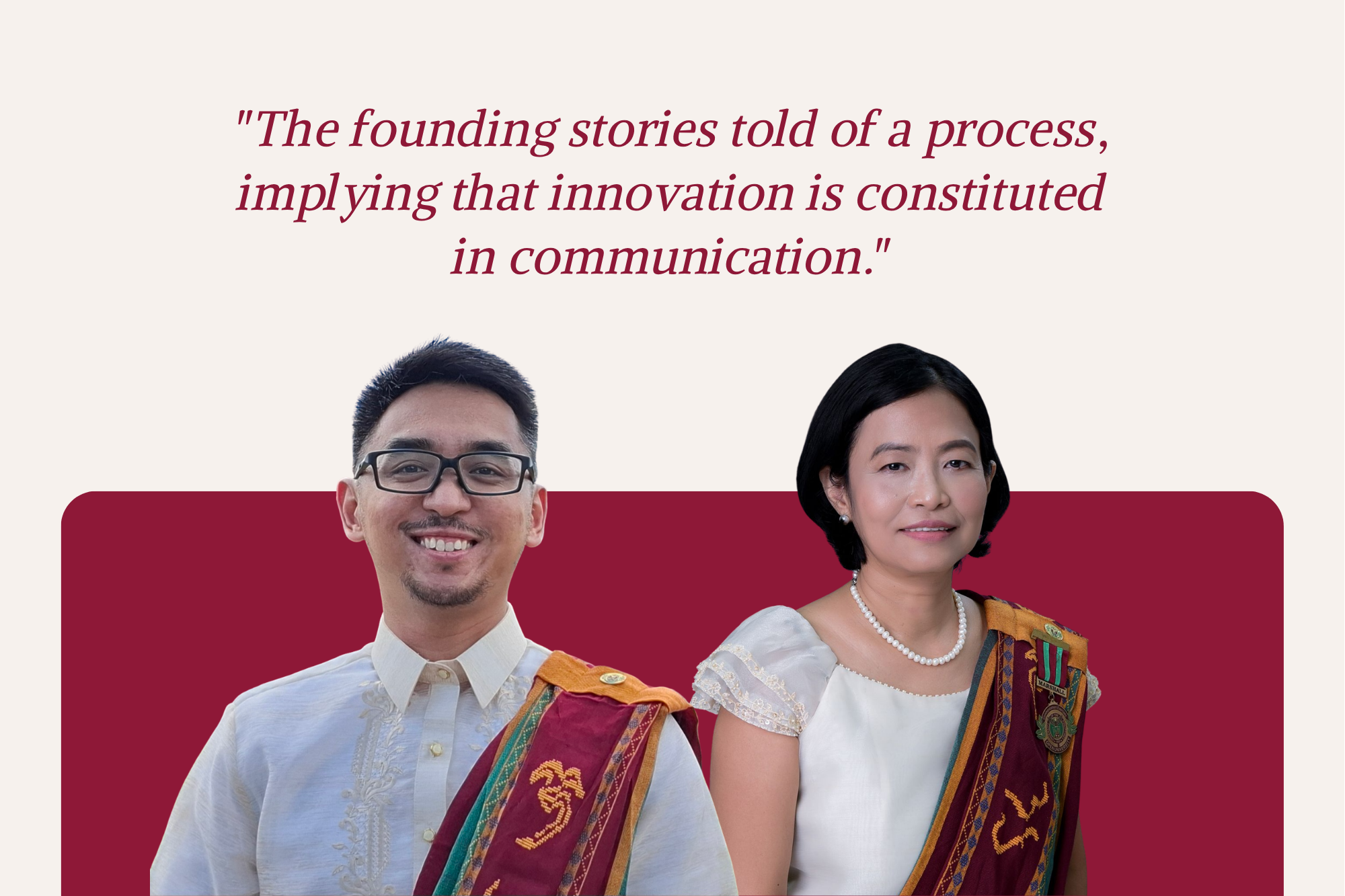
In their study of Filipino tech startups, Dr. Francis Raymond Calbay and Dr. Jean A. Saludadez show that innovation is not just a finished product but something that is constantly shaped by the stories that founders share.
Rethinking innovation
Most of us see innovation as a product that is created and transferred from the source (the inventor) to the user (the consumer). We often see mobile phone companies as innovative for coming up with useful and sleek features that convince consumers to purchase their products. Much of the research on innovation supports this view by defining innovation as an object passed from one person to another.
The authors argue that innovation is far more complex than simply creating a standalone product especially in the digital age. Today, technological development is built around interconnected platforms such as apps, social media, markets, and financial systems.
A mobile phone’s innovation, for example, goes beyond the device itself and includes app stores, digital payment systems, and app development ecosystems. Innovation also draws knowledge from multiple sources, including developers, investors, and users, and often emerges through the combination of existing systems and technologies rather than from scratch, as traditionally understood.
Many studies also present innovation as a result of an outcome of coordinated efforts of individuals and teams within an organization. But how is innovation actually created through these social processes?
Communication as foundation of innovation
Other researchers argue that innovation basically happens through communication between actors. A new phone feature only becomes real when a software developer tells his idea to her manager, who in turn, shares it with the engineers, designers, technicians, and consumers. The back and forth talking between these actors is what facilitates innovation. These “talks” can come in the form of narratives or stories that people in the organization tell each other.
Rather than treating these narratives as tools for creating innovation in an organization, Dr. Calbay and Dr. Saludadez’ study flipped this view by exploring how tech founders articulate and frame the concept of innovation from the founding stories they tell and how this version of innovation subsequently shapes the tech startup organization.
The study collected founding stories from 10 tech start up companies in the Philippines by interviewing the founders on how they developed innovations and organized their tech startups. Innovation is particularly relevant for tech start-ups as their very existence depends on it.
Innovation though storytelling
To make sense of the stories, the study examined how different roles and relationships shape the narrative. Drawing from Greimassian Narrative Theory, it explains that stories are not only driven by individual characters, but also by “actants,” or roles within the story that influence what happens. An actant can take on different roles such as a helper, opponent, sender, or receiver, and these roles can change as the story develops.
The founding stories unfold through several narrative phases. They often begin with “motivation,” such as when a founder who was once a jeepney driver wants to develop an app to help drivers avoid accidents, followed by “commitment,” where the founder presents the idea as a response to a local transport issue. In the “competence” and “performance” phases, the founder builds a team to develop and refine the app into a user-friendly tool. Finally, the “sanction” phase involves the app receiving recognition through awards, user adoption, and investor interest.
The study shows that innovation and the formation of a tech company are ongoing processes marked by conflicts rather than finished products. The app, which serves as the “object” of innovation, is often shaped by “opponents” such as technical issues, outdated government regulations, and infrastructure limitations. At the same time, innovation is supported by “helpers” such as founders, developers, business partners, mentors, investors, technological infrastructure, and end users. Startup tech companies continuously navigate and negotiate with these opponents and helpers as they develop both their innovations and organizations.
The study also shows that humans and nonhuman (systems and objects) help shape how startups develop. Drawing from the Communicative Constitution of Organizations (CCO) theory, they explained that communication exchanges such as emails, meetings, and pitching sessions help organize people, ideas, and resources into an organization, while nonhuman agents such as government regulations and technological infrastructure also influence organizational directions.
The narratives suggest that innovation moves between concrete elements such as people and technologies and more abstract elements such as ideas and visions. As different stakeholders contribute, innovation evolves and is continuously revised through feedback, negotiations, and interactions. Business models, for example, may change based on user feedback or employee input, showing that innovation is a negotiated process. In this sense, a vision statement is not just an idea, but already part of building the tech startup itself.
Their study goes beyond the usual depictions of innovation as a passive product by showing it instead as something continuously created through communication, negotiation, and collaboration. For founders of tech startups and other organizational leaders, the study suggests that vision statements are not just ideas expressed in stories but acts that help create both the innovation and the organization itself. Investors, technologies, users and other stakeholders support innovation as active participants in the narratives that shape the evolution of innovation and organizations.
Written by Primo Garcia | Visual layout by Marinela Hernandez