As a new academic year begins at UPOU, many new students are experiencing Open and Distance e-Learning (ODeL) for the first time. We look back at a recent podcast conversation with UPOU Chancellor Joane V. Serrano, where she discusses leading an open university, serving marginalized groups, expanding access to quality education, building a strong learning community, and the role of AI in teaching and learning.
As a leader, UPOU Chancellor Dr. Joane V. Serrano likens her leadership journey to art sand, a piece which she encountered during a visit to Berlin. Its ever-changing patterns, she says, reflect her own growth as an educator and leader.
“I saw this on a street in Berlin and thought, ‘Wow, it captured my attention because it’s like moving sand. The sand never completely stands still. It shifts, it flows, and it creates a different and unique pattern. I think this art sand captures my journey as an educator, from my student journey to my educator life.’ “
These reflections emerged during a recent podcast conversation with Prof. Judyth Sachs on the StudioSity YouTube channel, where Dr. Serrano discussed the evolving landscape of open and distance learning, equity in higher education, and UPOU’s role in responding to emerging opportunities and challenges.
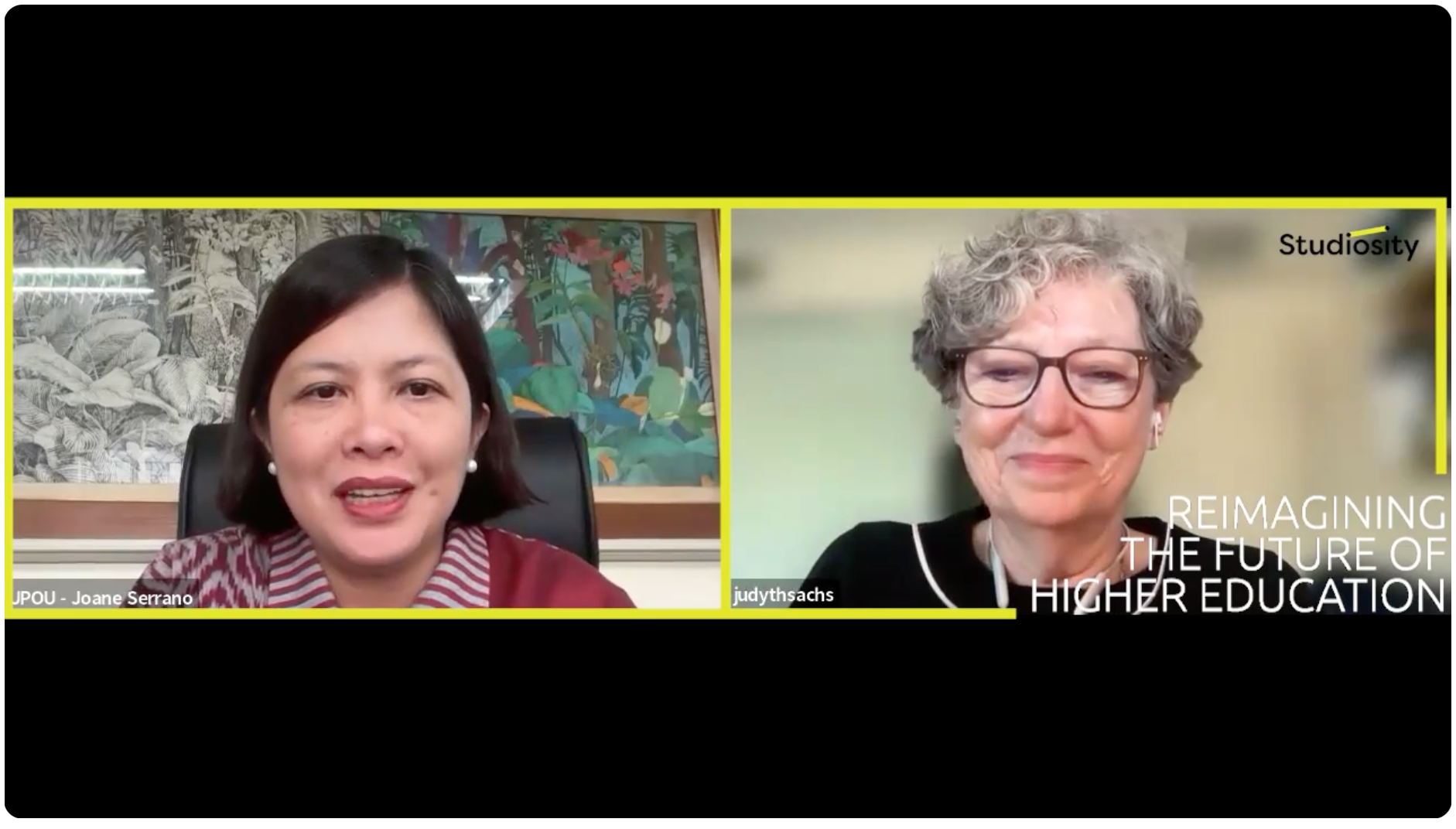
UPOU Chancellor Dr. Joane Serrano joins Prof. Judyth Sachs in a conversation on the future of open learning and the pursuit of greater equity in education.
Where it began
Dr. Serrano spent her elementary and high school years in the province of Camarines Sur. After passing the highly competitive University of the Philippines College Admission Test (UPCAT), she began her college journey at the University of the Philippines Los Baños (UPLB), a campus about a 12-hour drive from her hometown. Looking back, she believes her decision to study at UPLB was largely influenced by her parents, who encouraged her to pursue the opportunities that a UP education could offer.
“My father actually studied here, and during their time, it was actually very rare that students from the provinces were able to study in the national university, “ she said.
After completing her Bachelor of Science in Development Communication, Dr. Serrano pursued a Master of Management major in Development Management and later a PhD in Development Studies, both at the University of the Philippines Los Baños (UPLB). She said she deliberately chose to build on her foundation in development studies, with a particular focus on the intersection of communication and management
Leadership through participation
Her training in development communication, development management, and development studies has shaped not only her work with underserved communities but also her approach to leading an academic institution.
For Dr. Serrano, effective leadership begins with understanding people’s realities rather than relying on one-size-fits-all solutions.
“In managing higher education institutions, you cannot take a one-size-fits-all approach. You really have to go down to the ground, to everyone. You have to understand what the people on the ground are actually feeling,” she said.
She explained that the same principle guides how UPOU responds to the needs of its own community.
“For example, if you’re running an open university and you just assume that everyone knows technology, but then when you go to the ground and understand that some of the people, for example, our administrative staff, are not even very adept in using technology, then you have to address these challenges and design interventions to respond to them.”
UPOU’s learning mission
Appointed as Chancellor of the University of the Philippines Open University (UPOU) in 2025, Dr. Joane V. Serrano now leads the fifth constituent university of the University of the Philippines System. Established in 1995, UPOU was created to expand access to quality higher education for learners who are unable to attend conventional universities because of geographic, professional, or personal constraints.
“The UP System originally had four autonomous units. We were established in 1995, and our mandate was to widen access to quality education, especially to those areas that cannot be reached by the conventional University of the Philippines campuses. So our target really is the adult working population, full-time professionals, especially teachers,” she said.
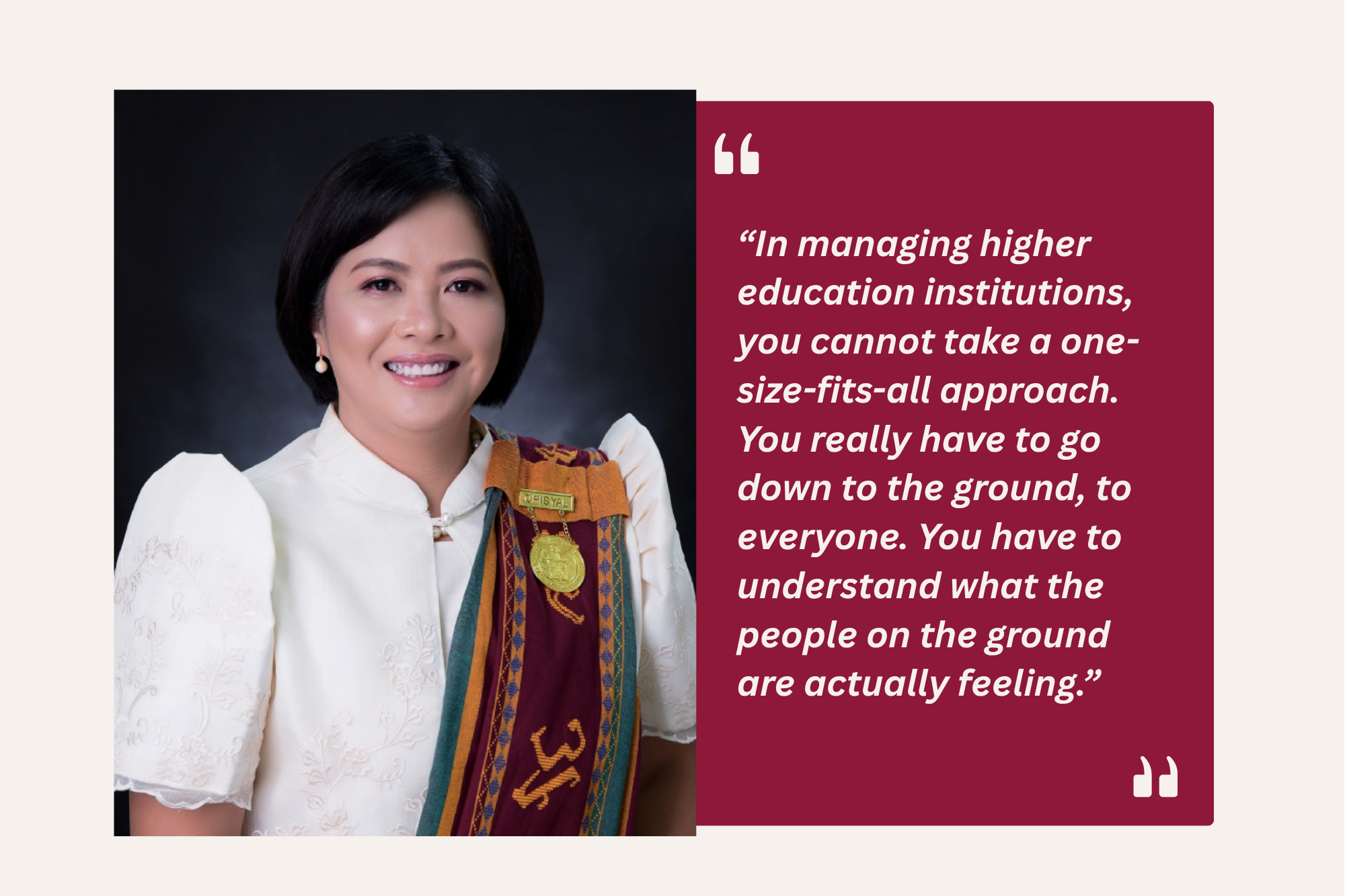
For Chancellor Joane V. Serrano, meaningful leadership starts with understanding people’s experiences and responding to their realities.
In its early years, UPOU focused on teacher education, recognizing that many Filipino teachers, particularly those assigned to remote communities, had limited opportunities to pursue graduate studies while continuing to work.
“Many of the teachers work in remote areas, and they don’t have the time to study for their graduate programs. Otherwise, they would have to apply for leave from their teaching responsibilities, and they would have to leave their families as well because they have to go to other areas to pursue their graduate education,” she said.
The University also sought to address teacher qualification gaps by offering programs that help educators strengthen their expertise in the subjects they teach.
“This is very intentional because one of the problems in the Philippines is that there are some teachers who do not have majors in the specific fields they are teaching, for example, in the sciences,” she explained.
Over the years, UPOU has expanded its mission beyond teacher education to provide lifelong learning opportunities for Filipinos whose education is limited by distance, financial constraints, or family responsibilities.
“That’s why we develop programs to address these particular needs. We reach out to adult working professionals, those who are financially challenged because attending a university means you have to spend for transportation, accommodation, food, and other expenses. It really takes a lot of resources to move to another place, rent a house, and study. We also think about women who cannot leave their families but would like to continue their learning.”
The university has likewise become an avenue for overseas Filipinos to earn formal qualifications and develop new competencies while working abroad.
“We have overseas Filipino workers in different countries, for example, teachers, nurses, professionals, and domestic helpers. We really want to capacitate them and help them upskill so they can move into better and lower-risk jobs. There are around 10 million Filipinos abroad, and we are reaching out to them so they can continue their studies. When they eventually return and reintegrate into the country, they will be better prepared. Or if they choose to stay where they are working, they will have opportunities for better-paying jobs,” she added.
Ensuring access and quality
UPOU significantly expanded its reach with the adoption of online learning. Drawing on years of experimentation with digital technologies, the university established a comprehensive open and distance e-learning system that made quality education more accessible and resilient even before the COVID-19 pandemic in 2020.
“In 2000, when the internet was starting to advance, we experimented with this mode of delivery. We partnered with a university in Singapore and started exploring an integrated virtual learning environment. Since then, we continued refining the approach until we were finally ready to deliver our courses fully online. But we do not deliver them synchronously, and we do not rely on lectures. We prepare what we call a resource-based course package. These include modules, video lectures, podcasts, and other learning resources that are carefully designed to provide the content our learners need. This is actually patterned after the model we used even before online delivery,” she said.
To ensure the quality of its learning resources, UPOU developed what Dr. Serrano described as a “quality circle,” which is an interdisciplinary team that reviews every course before it is offered.
“There’s a team of experts that develops the module. There’s the course author writing the content, an instructional designer ensuring that everything is aligned—from the learning outcomes to the learning activities and assessment. Then we have a language editor, a multimedia designer, and now a gender and inclusivity expert. We also have another content expert review the material to ensure that it reflects more than just one person’s perspective,” she said.
Building community of learners
While teaching and learning at UPOU are primarily asynchronous, the university has created opportunities for students to connect with one another through academic and co-curricular activities conducted in hybrid mode.
“It’s usually hybrid so that those who would like to come to the University can experience being on campus. But those who are prevented by distance have the opportunity to join online. We have a wide range of activities that allow engagement for our students,” she said.
Beyond classroom learning, UPOU is also strengthening student organizations to foster a greater sense of community among its geographically dispersed learners while providing spaces for students with shared interests to pursue their hobbies, advocacies, and passions.
“We’re strengthening the student organizations. Our Office of Student Affairs is working with different student bodies to develop student organizations and create a semblance of belongingness. We also encourage them to participate in different conferences, with support from the university. We also allow our students to be on campus as student assistants and volunteers in our public service projects,” she said.
Responding to AI’s opportunities and challenges
The rapid emergence of generative artificial intelligence (AI) has prompted higher education institutions to rethink how teaching, learning, and assessment are conducted while safeguarding academic integrity. At UPOU, AI is viewed not as a replacement for learning but as a tool that can enhance it when used responsibly and guided by clear institutional policies.
“This is something that we acknowledge and embrace. We’re not afraid of AI. We do acknowledge that this is a tool that will be there, but we do not say that we are driven by AI because we are not. We use it in our courses, and we let our students use it guided by our policies.”
“We allow certain activities, for example, brainstorming ideas. Our policy is that students cannot use AI for writing or crafting the material themselves. They can use it for developing topics based on the literature. So it’s something they can use, but it cannot replace their work. We’re very clear about that when it comes to our students,” she said.
Recognizing the rapid pace of AI development, UPOU continues to review its policies and teaching practices to ensure that the technology is integrated in ways that support learning while maintaining academic integrity.
“We continually review our policy. In fact, we just had a faculty session a few weeks ago on reimagining assessment in the era of AI. We constantly have these kinds of activities to review our AI policies and understand how our faculty members are using AI in their courses so that we can adapt accordingly. At the same time, our students also know what is expected of them when using AI and how they can use it to facilitate learning while ensuring that academic integrity is upheld,” she said.
What lies ahead?
Looking ahead, Dr. Serrano said UPOU has an even greater opportunity to fulfill its mandate by reaching learners who have long remained on the margins of higher education.
“I think we at the UP Open University now have the opportunity to really reach out to the target audiences that we want to reach—those in the margins, those in the small islands, teachers who cannot cross seas and rivers because they do not have the resources. There are now many universities offering courses online, which means the professionals that we used to target have more options.”
For Dr. Serrano, this allows UPOU to focus on the learners who continue to face the greatest barriers to education.
“It will still be very hard for many universities to reach those in the margins, those in remote areas, in the mountains, Indigenous Peoples. There are more than 130 ethnolinguistic groups in the Philippines. There are 10 million overseas Filipino workers. These are opportunities that actually excite me because this means we will now be able to focus on the target learners that we wanted to reach in the first place.”
Coming full circle
Reflecting on her own journey, Dr. Serrano shared that she once dreamed of working directly with marginalized communities through nongovernment organizations. While that path did not materialize, she said she has come to realize that, as an educator, she has been able to serve the very communities she had always hoped to help.
“If I could give advice to the younger Joanne, I would say, ‘Don’t worry too much.’ I wanted to go to the communities and help them. I wanted to work with the Mangyans, Indigenous Peoples, and other far-flung communities through NGOs. But that did not happen. That’s not a problem now. Now that I’m older, I’m actually able to help the communities that I wanted to serve in the first place—as an educator.”