


University of the Philippines Open University (UPOU) Chancellor Dr. Joane V. Serrano emphasized the need to connect microcredentials with further learning and career opportunities during the First Annual Conference and Assembly of the Association of Micro-Credential Council Philippines Inc. (AMCP). The event was held on 11-12 September 2026 at the SMX Convention Center, Mall of Asia Complex.
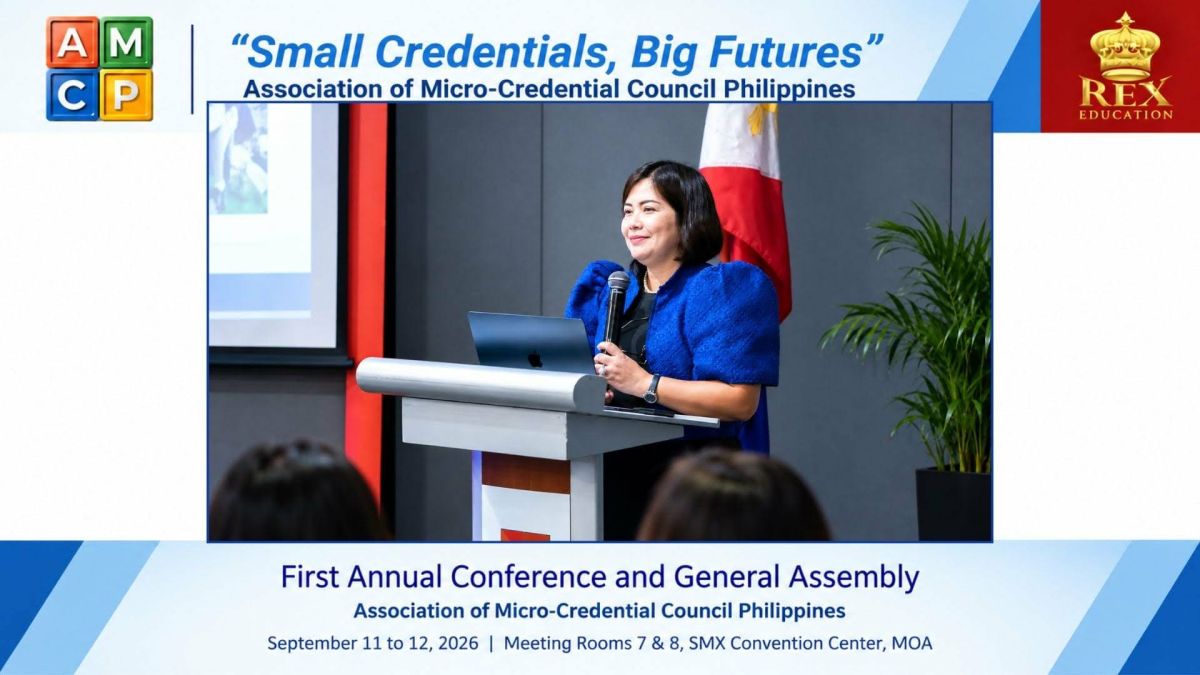
Chancellor Serrano discusses the importance of Microcredentials in Open Borderless Learning
Photo credit: Association of Micro-Credential Council Philippines Inc.
Chancellor Serrano delivered the message for the plenary session, “The Pivot towards Career Pathways and the Role of Open Borderless Learning,” The event carried the theme “Small Credentials, Big Futures,” with the first plenary session focused on “Micro-Credentials, Macro-Leadership: Governing the Future of Work.”
In her presentation, she emphasized that rapid changes in technology, industries, occupations, and workforce requirements have made lifelong learning increasingly important. “Education can no longer be treated only as a stage that comes before employment, as professionals may need to return to learning several times throughout their careers to acquire new competencies, upskill, or reskill,” she noted.
Microcredentials can help address changing learning needs by allowing individuals to develop specific competencies without pursuing another full degree.
“A credential can tell us what a learner has completed or demonstrated. A pathway tells us what that learning can make possible next,” Chancellor Serrano said.
She explained that microcredentials may stand alone or connect to further learning, professional development, and larger academic qualifications. Open and borderless learning can strengthen these pathways by making education more accessible across institutions, sectors, and countries.
UPOU initiatives illustrate these possibilities. These include Digital Workplace Competency Training based on the EU DigComp 2.2 framework; nine Nursing Education microcredentials stackable toward the Master in Nursing Education; chronic disease management microcredentials developed through the MICROCASA project; and the Philippine-Taiwan semiconductor initiative, which combines online learning, technical training, internship, and industry engagement.
Beyond individual programs, Chancellor Serrano emphasized the need for an ecosystem that ensures the quality, recognition, relevance, portability, and accessibility of microcredentials. She also cited CHED Memorandum Order No. 1, series of 2025, which provides national guidelines for their development and recognition.
“The more important question now is, ‘How do we make microcredentials work together as part of a trusted lifelong learning ecosystem?’” she said.
In closing, Chancellor Serrano emphasized that the potential of microcredentials lies not simply in offering shorter forms of learning, but in creating connections that allow individuals to continue learning and developing throughout their lives.
“Small credentials become more meaningful when they open pathways–to further learning, professional growth, and lifelong opportunities,” she said.
Written by Sydney Rovin Macahiya | Edited by Anna Cañas-Llamas and Primo Garcia | Photo credit: Association of Micro-Credential Council Philippines Inc.


Related Stories:
 UPOU Chancellor visits Kaohsiung institutions to advance microcredentials, discuss research initiatives, and strengthen partnerships
 UP Open University Chancellor delivers commencement addresses at BU and SorSU graduate school ceremonies in Bicol
 Bringing education closer to communities through partnership: UPOU explores collaboration with Tarlac City LGU